
Your needs, this model
Does it fit your priorities?
Does the Satori Smart T2400 automatically change resistance in an app?
No. Tacx describes the T2400 as manually controlled with ten resistance positions. Its Bluetooth/ANT+ links and app-accessible calibration mode do not establish app-controlled braking; the handlebar lever remains the resistance control.
Explore this need in the finder →What bike setup does the T2400 use?
The T2400 keeps the rear wheel installed and presses the tire against the resistance cylinder. It is not a free-standing balance-on-drums roller, and it has no cassette or Cog/Click trainer package; check the actual skewer, fitting pieces, tire and frame clearance on the specific used or old-stock unit.
Explore this need in the finder →Does the T2400 meet a 10% simulated-grade minimum?
Tacx's 2019–2020 overview lists a 10% maximum simulated slope at 75 kg total mass. That source-based limit meets a 10% minimum but not 11%; it is not a measured or rider-specific hill guarantee, and the maker's older catalog copy was reader-accessed rather than directly downloaded.
Explore this need in the finder →This is a source-based assessment of the earlier U.S.-listed Tacx Satori Smart Trainer, model T2400—not a hands-on review. Best Buy's U.S. record identifies T2400 and SKU 6375934, while Garmin's own T2400 manual and parts sheet establish the machine's model-specific setup. A retailer record proves that this model was offered in the U.S.; it does not promise that another seller has stock, a complete box or a serviceable used unit. The T2400 manual and Best Buy model listing are useful starting points.
The T2400 is wheel-on, not direct drive or free-standing rollers
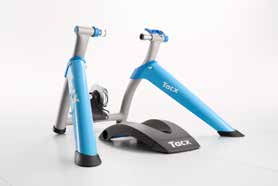
The Satori holds the bicycle at its rear axle while the installed rear tire presses against a resistance cylinder. That makes it a wheel-on frame trainer. It is not a direct-drive unit that replaces the wheel with a cassette body, and it is not the open three-drum roller format where the rider balances on the equipment. The T2400 manual has a setup sequence for positioning the resistance unit against the wheel and choosing an insert for handlebar diameter; its parts sheet identifies the separate frame, brake unit, quick-release hardware and bar-mounted control. Those diagrams help identify the design, but they are not proof that a second-hand seller still has each piece.
Wheel-on convenience comes with the usual tire-contact chores. The actual tire, rim, wheel diameter, skewer and frame need to work together; the manufacturer instructions for your bicycle and tire take precedence over a broad compatibility label. The trainer's resistance cylinder touches the tire, so a rider who wants to avoid tire contact, has unusual rear-end geometry, or needs a guaranteed fit should check the exact setup before selecting it.
“Smart” here means wireless data—not an automatically controlled brake
The product name can mislead a buyer who uses “smart trainer” to mean that Zwift or another workout app changes resistance by itself. Tacx's T2400 specification calls the trainer manually controlled and shows ten selectable resistance positions. The handlebar lever is the brake control. The manual also lists Bluetooth 4.0 and ANT+ and says calibration mode can start at power-on or through the app. That is different from software setting the brake for a virtual climb or ERG workout.
The distinction is worth keeping even though the T2400 does communicate. Tacx describes power measurement, while the manual lists wireless links and two AA batteries for its electronics. Those features can support data display or app-based training functions; they do not turn the magnetic brake into an electronically controlled one. Garmin's support material continues to list Satori Smart as a supported legacy model, but current app compatibility does not establish every device, mode or software version—and it does not change how the lever operates. A buyer who requires automatic app resistance should compare direct-drive models such as the separately assessed FLUX S T2900S.60, not infer control from the Satori's name.
Use the grade number with its stated condition
Tacx's 2019–2020 overview lists a maximum resistance of 950 W, power accuracy below 10%, a 1.6 kg flywheel and a maximum simulated slope of 10% at 75 kg total mass. These are manufacturer specifications preserved from the model table, not independent measurements or a promise about how a particular rider will experience a virtual climb. In the finder, the published 10% figure meets a 10% minimum and does not meet an 11% minimum. It should not be read as a personalized grade capability without the manufacturer’s rider-and-bike assumptions.
The number is also not an app-control claim. A ten-position manual brake, a reported watt estimate and a simulated-grade field describe different capabilities. The Satori has a numeric grade statement in the historical Tacx table; the adjacent Blue Matic T2650 and Blue Twist T2675 assessments keep their own grade values unknown because their checked sources do not document one. Do not transfer a figure from one wheel-on trainer to another.
Confirm the exact unit and its small parts
Garmin's T2400 parts sheet labels a quick release, handlebar lever and fittings, and the owner's manual asks the owner to check the package before assembly. Neither document verifies what a particular used seller will ship. Ask for a clear photo of the T2400 identification label, resistance unit, cable and lever, rear-wheel fixing hardware, handlebar inserts and every fitting part. Check wear or damage, the seller's return terms and whether the parts list matches the actual box.
There is also a source disagreement about total weight. Garmin's parts sheet prints 9.5 kg, while U.S. retailer text reports 17.1 lb. The materials do not make clear that the figures use the same definition or whether one includes packaging, so this assessment does not pick a number for comparing lifting or storage. Dimensions and the complete U.S. kit likewise remain unconfirmed.
Where it sits among earlier Tacx choices
The Satori's useful middle ground is wireless training data paired with manually selected resistance. The Blue Matic T2650 also uses a handlebar lever but has a different, separately documented T2650 brake; Blue Twist T2675 moves its seven-position control to the resistance unit. By contrast, the FLUX S T2900S.60 removes the rear wheel, uses a cassette body without a cassette in the standard package, needs external power and supports app-controlled resistance in its connected mode. These are not interchangeable setups even if they all appear in an indoor-trainer search.
Who should keep the Satori on a shortlist?
T2400 is a plausible candidate for someone who specifically wants the rear wheel to stay on, prefers a manual lever and can make use of wireless performance data without expecting the app to steer the brake. It is a poor fit for someone whose essential need is automatic resistance, a verified ready-to-ride used package, or a fit guarantee. Its 10% grade entry has a 75 kg total-mass condition, and a seller still needs to prove the exact unit and fittings. Treat this as an earlier model assessment, not a stock promise or a record of riding experience.
Key specifications
Key details at a glance
| Trainer setup | Wheel-on / rear tire on |
|---|---|
| App-controlled resistance | No |
| Manufacturer maximum resistance power | 950 W |
| Maximum simulated uphill grade | 10% |
| Cassette included in reviewed package | No |
| Zwift Cog and Click included in reviewed package | No |
| Listed connection protocols | Bluetooth / ANT+ |
| Listed ride metrics | speed / cadence / power |
| AC power adapter included | No |
| Mains power required for powered resistance | No |
Use the exact model’s instructions for operating limits, supplied equipment and version differences.
Sources for this review
Sources for this assessment
- Tacx Indoor Trainers — Garmin U.S. Previous Models (search-reader extract)
- Satori Smart T2400 Owner's Manual — Garmin/Tacx
- T2400 Satori Smart Parts Sheet — Garmin/Tacx
- Tacx Trainer Overview 2019–2020 (manufacturer document, search-reader extract)
- Tacx Satori Smart Trainer — Garmin U.S. Customer Support product route
- Tacx Training App Compatibility and Requirements — Garmin Support reader
- Tacx Satori Smart Bicycle Trainer Black and Blue, model T2400 — Best Buy U.S.
- Tacx Satori Smart Trainer, model T2400 — Walmart U.S. listing reader
See how this setup fits your own priorities.
The finder uses documented setup and feature differences. It is not a compatibility guarantee; verify your exact frame, drivetrain and supplied package.