
Your needs, this model
Does it fit your priorities?
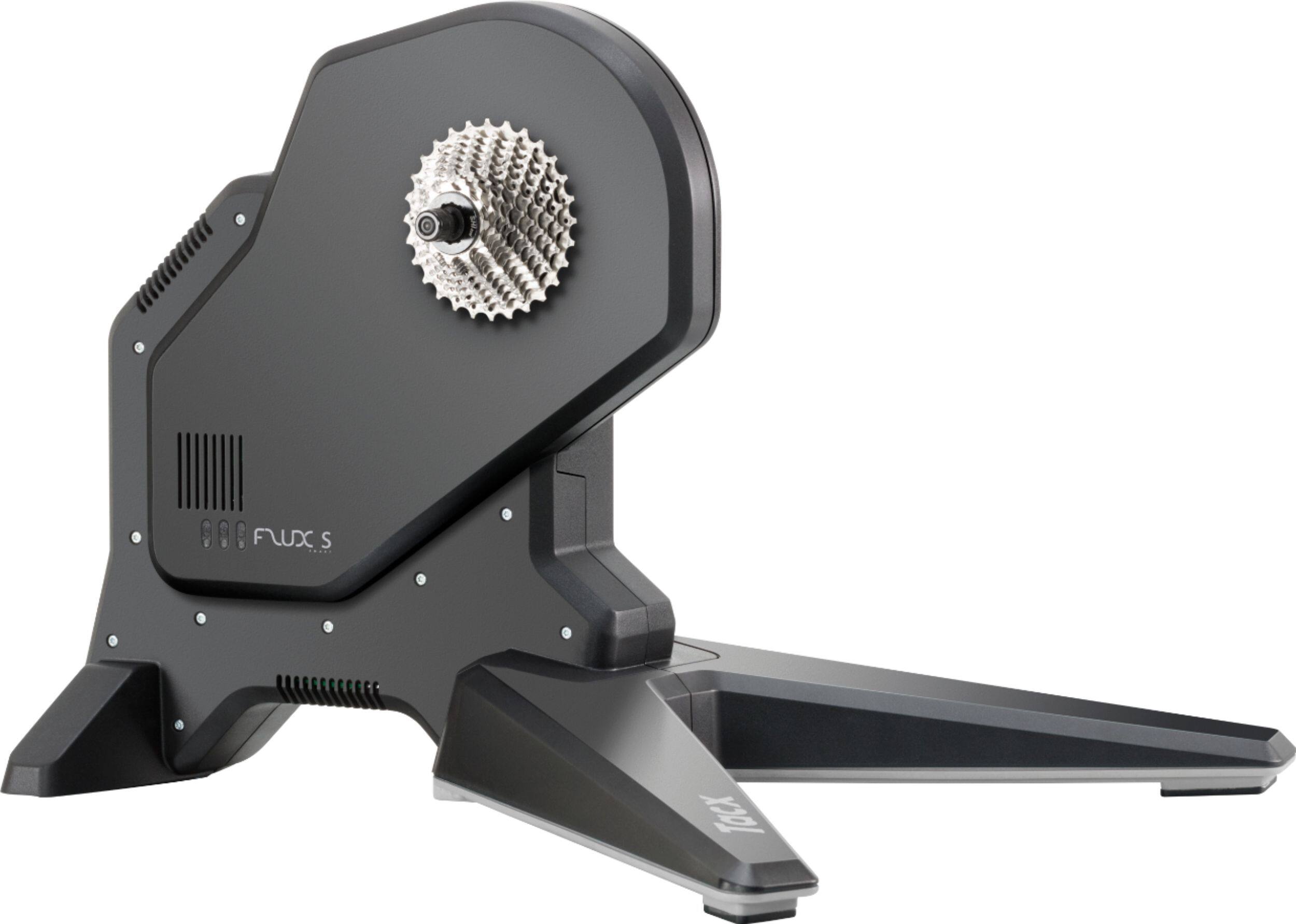
Does the U.S. FLUX S T2900S.60 include the cassette shown in some images?
No. Garmin's FLUX 2/S owner manual explicitly says a cassette is not included, even though the trainer has a standard Shimano/SRAM cassette body. The manual lists a spacer and axle end caps; verify the exact U.S. box and select a compatible cassette for the bike before ordering.
Explore this need in the finder →How does the FLUX S change resistance?
Garmin describes a connected, powered app mode with app control of the electronic brake. The owner's manual says powered standalone mode simulates a flat road and resistance increases with speed. It requires an external power connection; this is different from the wheel-on Satori Smart T2400, whose resistance remains at a manually selected lever setting.
Explore this need in the finder →Does the FLUX S meet a 10% uphill-grade minimum?
Garmin lists a 10% maximum simulated incline for the T2900S family. That supports a 10% minimum but not 11%; it is a manufacturer specification, not an independent measurement or an individualized climbing guarantee.
Explore this need in the finder →This is a source-based assessment of the earlier U.S. Tacx FLUX S Smart Trainer, model T2900S.60—not a hands-on test. U.S. retailer records from Best Buy and Crutchfield identify that exact model number, while Garmin's FLUX 2/S owner manual names T2900S among the supported units. Garmin's separate regional T2900S.62 product page supplies manufacturer performance figures, but its regional suffix and package are not substituted for the U.S. T2900S.60 offer. Retailer model records establish a U.S. offer was observed, not current or future availability.
Direct drive makes the bicycle's rear axle the first fit check
The FLUX S removes the bicycle's rear wheel, then the rear axle mounts into the trainer. That is a different routine from the wheel-on Satori Smart T2400, where the tire stays installed and drives a roller. Garmin's owner manual instructs the user to remove the wheel, align the axle and secure it, then rotate the crank to check clearance. It lists a standard 130 mm quick-release setup and alternative end caps for 135 mm quick release and 12 x 142 mm or 12 x 148 mm thru-axle bikes. Verify the exact physical kit and bicycle standard; a family name alone cannot establish fit.
App control requires a powered connection
The FLUX S is a true smart-resistance setup in its connected operating mode. Garmin's manual distinguishes powered-and-connected training, where the app can control the trainer, from powered standalone operation, which simulates a flat road with resistance rising as speed rises. The product requires an external power connection, and Garmin lists a country-specific cable in its package parts. Bluetooth and ANT+ communication, trainer-reported speed/cadence/power and current app support make it a more structured option than an earlier manual trainer, but they do not guarantee that every phone, app, workout mode and software release will work with every unit.
Garmin lists spin-down calibration for this model family. The published calibration method should not be mistaken for a claim that this review measured power accuracy or ride feel. If a used trainer is being considered, confirm that its power supply is present and undamaged, that the trainer pairs with the intended device, and that the seller can identify the exact model and axle end caps.
The cassette is separate, even when the photo shows one fitted
Garmin's T2900S manual explicitly says the cassette is not included. The standard freehub body accepts Shimano/SRAM cassettes, while the manual says a spacer is used for 8-, 9- and 10-speed cassettes and no spacer for 11- or 12-speed Shimano/SRAM cassettes. Campagnolo, SRAM XD and XD-R require a different, separately purchased body. Garmin's T2900S.62 regional product page instead lists Shimano/SRAM 8–11 speed and separately available bodies for other standards. Because those first-party descriptions do not say the same thing, this assessment leaves one universal speed-count answer unresolved. Identify the exact freehub, cassette and spacer instructions for the T2900S.60 unit before ordering; do not treat “Shimano/SRAM” as enough to ensure a chain and derailleur will match.
The Best Buy product image associated with T2900S.60 shows a cassette already fitted. It is a product photograph, not evidence that the cassette comes in the retail box. The manufacturer manual controls that package decision: plan to supply a compatible cassette separately. No Zwift Cog and Click package is identified for this standard U.S. configuration.
Ten percent is a published ceiling, not a ride test
Garmin's FLUX S specification lists 1,500 W maximum power, a maximum simulated incline of 10%, 22.1 Nm torque, 65 N brake force and a 7 kg flywheel; its stated power accuracy is under 3%. These are maker figures, not independent measurements. The grade comparison is straightforward at its published threshold: the model meets a 10% minimum and drops out at 11%. It is not a personalized promise about the hill a rider will feel, and an older software environment or incomplete seller package may affect whether an app workout works as expected.
The trainer's listed footprint is about 670 x 642 mm and its listed weight is 22.8 kg. A direct-drive unit also needs space to remove and reinstall the rear wheel and room to handle its power cable and bike. The T2900S family sources list a spin-down calibration step; they do not establish noise in a particular home, the condition of the drivetrain, or how a rider will experience resistance.
Distinguish FLUX S from FLUX 2 and NEO packages
FLUX S is not the current-reference FLUX 2 T2980.60. The FLUX 2 assessment publishes a different 16% grade limit and a separate cassette-speed wording conflict; its facts must not be transferred to T2900S. The FLUX S has the lower documented 10% ceiling and its own 1,500 W specification. Both standard versions are direct-drive and cassette-not-included, but identical mounting and box basics do not make the models equivalent. Nor should it be confused with NEO 2T Cog/Click, a package that supplies Zwift components the standard FLUX S does not include.
Who might choose the earlier FLUX S?
It makes sense to compare T2900S.60 when a rider wants direct-drive, app-controlled resistance, is comfortable choosing and installing a cassette, has the correct power and axle parts, and is satisfied with the 10% manufacturer-listed incline ceiling. It is a poor match for someone who wants a cassette preinstalled, needs a published grade above 10%, cannot use the exact axle arrangement, or expects the product image to show the package contents. Check the actual unit, cassette body, spacer, end caps, power cable, app support and seller terms. This is a model assessment, not an availability guarantee or a report of personal use.
Key specifications
Key details at a glance
| Trainer setup | Direct-drive / rear wheel removed |
|---|---|
| App-controlled resistance | Yes |
| Manufacturer power accuracy | 3% |
| Manufacturer maximum resistance power | 1500 W |
| Maximum simulated uphill grade | 10% |
| Cassette included in reviewed package | No |
| Included cassette/freehub standard | Standard Shimano/SRAM cassette body; verify speed range, spacer and freehub. Other listed cassette standards require a separately purchased compatible body. |
| Zwift Cog and Click included in reviewed package | No |
| Listed connection protocols | ANT+ / ANT+ FE-C / Bluetooth |
| Listed ride metrics | speed / cadence / power |
| Listed rear hub standards | 130 mm quick release / 135 mm quick release / 12 x 142 mm thru axle / 12 x 148 mm thru axle |
| AC power adapter included | Yes |
| Mains power required for powered resistance | Yes |
Use the exact model’s instructions for operating limits, supplied equipment and version differences.
Sources for this review
Sources for this assessment
- Tacx Indoor Trainers — Garmin U.S. Previous Models (search-reader extract)
- Tacx FLUX 2/S Owner's Manual — Garmin
- Tacx FLUX S Smart Trainer, regional model T2900S.62 — Garmin Singapore
- Tacx FLUX S Smart Trainer Black, U.S. model T2900S.60 — Best Buy U.S.
- Garmin Tacx FLUX S Smart Trainer, manufacturer number T2900S.60 — Crutchfield U.S.
- Tacx Training App Compatibility and Requirements — Garmin Support reader
- Tacx FLUX S Smart Trainer T2900S.60 product image — Best Buy U.S.

See how this setup fits your own priorities.
The finder uses documented setup and feature differences. It is not a compatibility guarantee; verify your exact frame, drivetrain and supplied package.