
Your needs, this model
Does it fit your priorities?
Does the Tacx Blue Twist T2675 keep the bicycle's rear wheel installed?
Yes. The T2675 holds the bicycle at the rear axle while the tire turns against its resistance cylinder. Measure the wheel and confirm the physical axle adapters with the seller; the old product label does not prove fit for every bicycle.
Explore this need in the finder →Can a training app control Blue Twist T2675 resistance?
No automatic resistance control is documented. Its seven positions are selected on the brake-unit switch before riding. An optional speed/cadence sensor can support estimated virtual-power display in compatible software, not app-driven braking.
Explore this need in the finder →Does Blue Twist T2675 include a cassette or Zwift Cog and Click?
The reviewed basic wheel-on configuration is not a cassette or Cog/Click bundle; the bicycle keeps its own rear wheel and drivetrain. Garmin's regional model record lists a quick-release skewer, but the U.S. retailer did not itemize the exact box, so verify the seller's actual kit.
Explore this need in the finder →This source-based review covers the earlier Tacx Blue Twist Basic Trainer, U.S.-offered part T2675. It is separate from the similar Blue Matic T2650. Garmin's U.S. support record describes a 1.2 kg flywheel, manual brake-unit control and sensor-derived virtual power; Performance Bicycle's U.S. page names the specific T2675 offer. Neither source is evidence of an individual unit's condition or of a live seller stock position. The checked retailer record marked the product discontinued online on November 1, 2026, a dated page observation only.
Seven positions, set at the brake
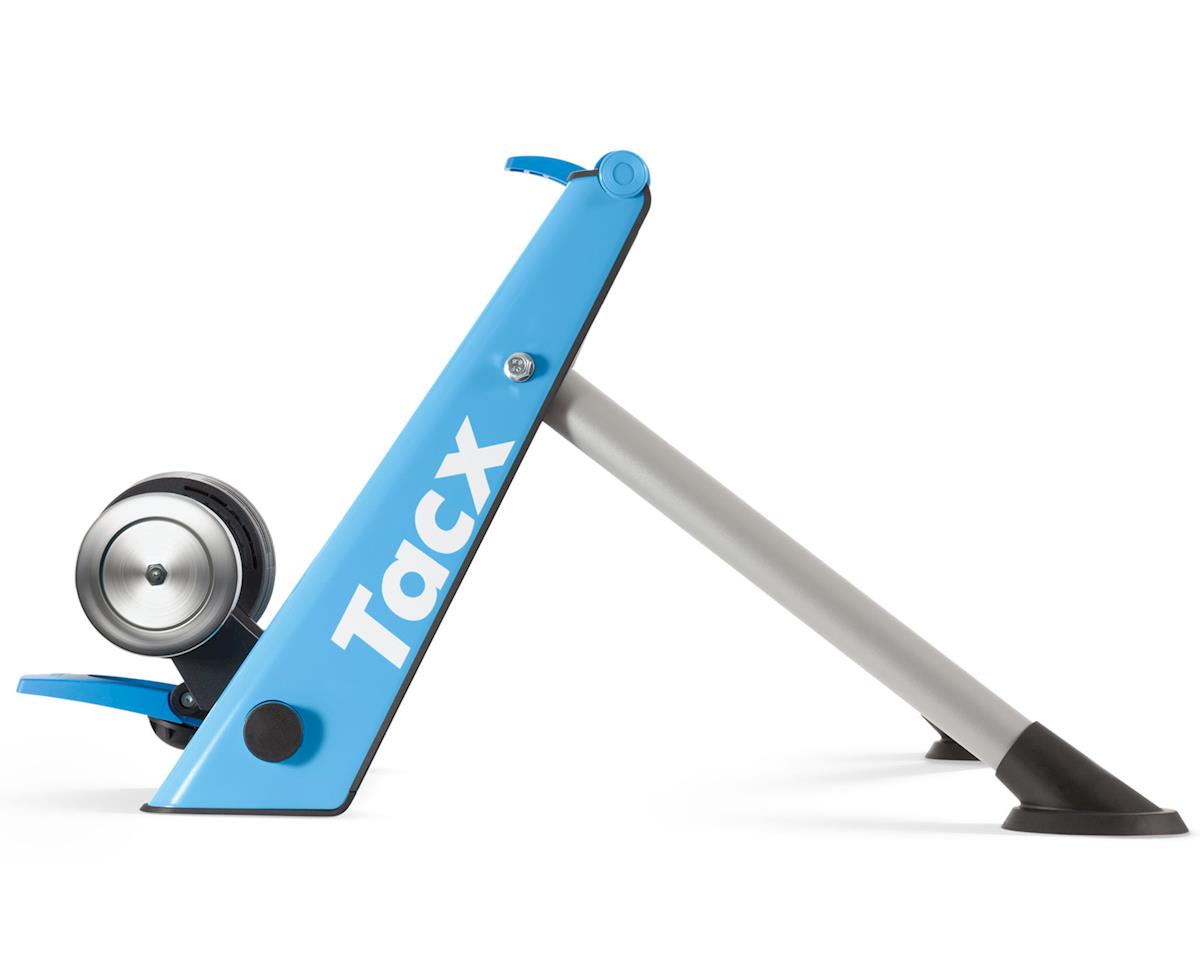
Blue Twist is a wheel-on magnetic trainer: the bicycle's rear wheel stays fitted, the frame is secured at the rear axle, and the tire presses against the resistance cylinder. Its most important distinction from the Blue Matic is the control location. The shared Tacx assembly manual shows ten positions on a handlebar lever for the Blue Motion/Matic models, then separately shows Blue Twist's seven-position switch mounted on its brake unit. You set that switch at the trainer before riding. That is a meaningful workflow difference, not a spelling variation or a new smart-trainer mode.
Garmin's T2675 model page calls the brake magnetic and lists 2 x 8 ferrite magnets, a 1.2 kg flywheel, no mains requirement and a maximum power statement. The product has no documented wireless communication or automatic brake control. A compatible speed/cadence sensor can send speed and cadence data to supported apps, where software may estimate virtual power. That is a sensor-based estimate, not direct power measurement, and it does not let an app change the Blue Twist's resistance to follow a route or structured ERG workout. Check the exact sensor, device, app and current support if virtual-power display is part of the plan.
There is a real version conflict in the wattage record: Garmin's current support and later T2675 product information say up to 700 W, but an older 2013 Tacx technical overview lists 650 W. Neither is an independent measurement or a rider-specific guarantee. We preserve the discrepancy rather than present a single maximum as a dependable performance promise. There is no documented simulated-grade percentage for this model, so the power figure cannot substitute for a climb rating.
Fit, setup and the U.S. box
The shared Blue trainer assembly guide instructs the owner to measure the wheel diameter to position the resistance unit. Garmin's regional T2675 product record lists 130 mm road and 135 mm mountain-bike rear-fork widths, with adapters available for other widths. That is useful model-level guidance, but the U.S. retailer listing does not itemize its complete box. Do not assume that an older unit still has its original quick release, axle fittings or small parts; ask the seller for photographs of the actual trainer and kit, then compare the bike's axle, dropout spacing, wheel diameter, tire and frame clearance to the instructions.
Garmin's U.K. page for the same T2675 part number lists the Blue Twist trainer and a 5 mm quick release in the box. Because Performance Bicycle's U.S. offer does not publish a matching contents list, that regional checklist is a cross-check—not proof that every U.S. or used seller supplies the same kit. The wheel-on design keeps the bicycle's own cassette and drivetrain on the bicycle; it is not a direct-drive cassette or Zwift Cog/Click bundle. Check for seller-added accessories separately.
The manual also matters for ownership. It says to release the cylinder from the bicycle tire when the trainer is not in use, to avoid abrupt braking, and to let the brake enclosure cool after prolonged intensive riding. It provides wheel and tire setup instructions, but a generic diagram cannot override the rating of a particular tire or rim. Noise is also not settled by a maker's “quiet” description: tire construction, surface, pressure, floor and room transmission remain part of the setup, and this assessment contains no sound test.
Blue Twist versus the Blue Matic
The two products share a basic magnetic wheel-on architecture, but their setup routines differ. Blue Matic T2650 has ten selections at the handlebar and a 1.25 kg flywheel; Blue Twist T2675 uses seven selections at the brake unit and a 1.2 kg flywheel. If reaching the trainer mid-ride is inconvenient, the control location is a practical reason to prefer the Matic—provided the T2650 is actually in the seller's package and its cable works. If a simple preset switch is acceptable, Blue Twist remains a distinct basic option. Neither becomes smart when paired with a speed sensor; they remain separate from newer wheel-on Tacx models such as Boost, whose specification and package evidence belongs to that product only.
Who should consider the T2675?
Blue Twist fits a rider who wants a compact, unpowered wheel-on trainer, is content to select resistance at the brake before riding and has a verified T2675-compatible axle and tire setup. It is not for someone who expects app-driven resistance, guaranteed accurate power, a published grade simulation limit or automatic virtual shifting. The model is documented, and a U.S. retail bridge exists, but seller condition, current availability and the physical accessory kit are all unit-specific. This is an evidence-based product assessment, not a test ride, ownership claim or promise that a particular bicycle fits.
Key specifications
Key details at a glance
| Trainer setup | Wheel-on / rear tire on |
|---|---|
| App-controlled resistance | No |
| Cassette included in reviewed package | No |
| Zwift Cog and Click included in reviewed package | No |
| AC power adapter included | No |
| Mains power required for powered resistance | No |
| Manual resistance levels | 7 levels |
Use the exact model’s instructions for operating limits, supplied equipment and version differences.
Sources for this review
Sources for this assessment
- Tacx Indoor Trainers — Garmin U.S. Previous Models
- Tacx Blue Twist Basic Trainer — Garmin U.S. product route
- Features of the Tacx Blue Twist Basic Trainer — Garmin U.S. Support
- Tacx Blue Twist Basic Trainer T2675 — Garmin U.K. product record
- Blue trainers: Blue Motion, Matic & Twist assembly manual, T2600.25B (2017-03)
- Garmin Tacx Blue Twist Trainer, part T2675 — Performance Bicycle U.S.
- Blue Twist T2675 product image — Performance Bicycle U.S.
- Tacx 2013 trainer overview — Blue Twist T2675 archived specification

See how this setup fits your own priorities.
The finder uses documented setup and feature differences. It is not a compatibility guarantee; verify your exact frame, drivetrain and supplied package.