
Your needs, this model
Does it fit your priorities?
Does Quick-Motion hold the bicycle at the rear axle?
No. It is a free-standing roller set: both bicycle wheels sit on moving drums and the rider balances the bike instead of fastening the rear axle. Elite's parabolic drums help guide the wheels, but they are not a frame clamp or a substitute for learning to mount and stop safely.
Explore this need in the finder →Can an app change Quick-Motion's resistance?
No. Elite specifies three magnetic levels selected by hand at the central drum. Optional Misuro B+ data and app compatibility do not automate the brake; for app-led resistance workouts, assess a genuinely interactive model such as Elite Nero instead.
Explore this need in the finder →How do I check whether my bicycle fits these rollers?
Measure axle-to-axle wheelbase and compare it with Elite's 944–1,144 mm interval, supported by eleven front-roller positions. Elite also lists a 110 kg maximum load; read the exact instructions to determine how the limit applies to rider and bicycle together.
Explore this need in the finder →Do I need to install a cassette or Zwift Cog on Quick-Motion?
No trainer cassette or Cog/Click drivetrain setup is documented: the bicycle keeps its own rear wheel and drivetrain on the drums. The Todson page does not enumerate every box item, so ask the seller about the optional Misuro B+ if app telemetry matters; do not assume that sensor or the disputed app-subscription term.
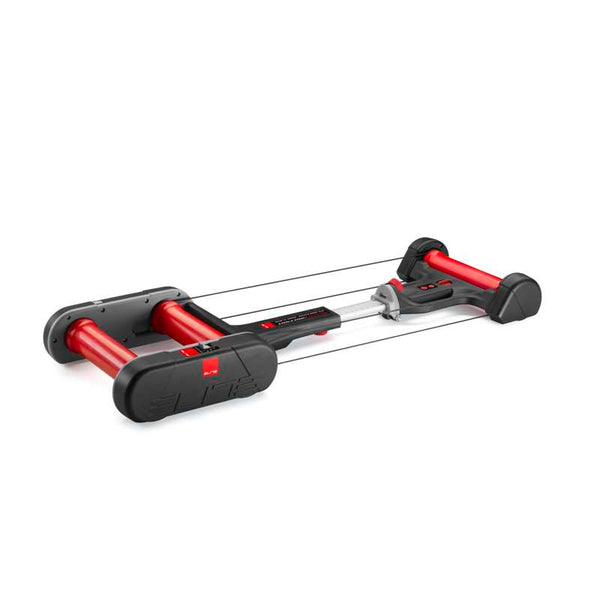
Explore this need in the finder →Elite Quick-Motion is a free-standing roller trainer, not a frame-clamping wheel-on unit. The bike keeps both wheels, rests on three drums, and remains free to move while the rider balances and steers. Its particular mix is a floating frame, parabolic drum ends and three manual magnetic resistance levels. The distinction matters: a phone connection or an optional sensor does not turn this brake into an app-controlled smart trainer.
What Quick-Motion changes about the ride
The rollers support a whole bicycle rather than fastening its rear axle. Elite says the front drum can be moved among eleven positions for a 944–1,144 mm wheelbase. That is a useful but not universal fit interval; measure the distance between axle centers on the bike you intend to use. The rider still needs to manage balance, mount and stop with care, and have enough clearance around the trainer to step away. This is a poor match if the main goal is to hold the bike upright while attention is elsewhere.
The floating section moves slightly fore and aft with pedaling, while the raised drum edges are meant to guide a tire toward the center. Those features may make the format less abrupt than a rigid basic roller, but they do not restrain the bicycle or eliminate balance practice. They should be understood as design features, not promises of effortless use. Riders who want an entirely fixed rear end should compare a wheel-on trainer; riders who want a fixed-frame, wheel-off arrangement should start with a direct-drive model.
Three manual resistance levels, not smart control
Elite's current product page and its 2026 technical sheet describe three magnetic levels selected at a manual adjuster on the center drum. Elite presents the low, middle and high settings as ways to vary the work while retaining the roller format. The trainer does not receive a workout command and change its brake automatically, so it is not the right fit for a shopper who requires app-led ERG intervals or automatic grade changes.
Quick-Motion can support ride-data use through an optional Misuro B+ sensor. Elite describes speed and cadence transmission over ANT+ and Bluetooth Smart, and estimated power in My E-Training; it also says an external power meter can supply power data to other apps while resistance remains under manual control. The exact U.S. importer page does not establish that the sensor comes in the box. Treat sensor inclusion as a model/package check, and do not confuse telemetry with a controlled resistance unit.
The same technical sheet lists 185 W at 20 km/h and 425 W at 40 km/h. These are manufacturer speed-dependent resistance figures, not a measured power-meter accuracy rating or an uphill simulation percentage. Elite does not publish a simulated-grade maximum for Quick-Motion in the checked product material, so a numerical grade requirement should not be inferred from those watt figures.
Measure the bike and room before choosing
For a fit check, compare the bicycle's wheelbase with Elite's stated 944–1,144 mm range and then confirm tire and frame requirements in the exact instructions. The technical sheet lists a 110 kg maximum load; ask the seller or maker how that limit applies to the rider and bicycle together rather than treating it as a rider-weight allowance. The trainer itself is listed at 11.5 kg. Elite gives an open footprint of about 1,400 × 520 × 160 mm and a folded size of 520 × 450 × 300 mm. Folding can make it easier to put away, but those dimensions are not a full estimate of the space needed to ride, mount, or recover balance.
Quick-Motion has no mains-power connector in Elite's sheet. That keeps the basic manual resistance arrangement independent of a powered brake. The included-app period is less clear: the current product page says one year of My E-Training, while its linked technical sheet says one month. Because the primary sources conflict, this assessment does not promise a subscription duration. Confirm the exact terms on the offer and included registration documents.
How it differs from other rollers
Quick-Motion sits between simple free-spinning rollers and interactive models. Standard Elite Arion lists no resistance levels; Arion Mag adds three manually selected magnetic levels. Quick-Motion also has three manual levels, but adds a floating frame and an optional data route. The more important functional contrast is with Elite Nero: Nero uses an electronically controlled magnetic brake and supports app-controlled resistance, yet the bicycle remains free on rollers in both designs. Read the separate Nero assessment if automatic control is essential, and compare the standard Arion and Arion Mag when deciding whether manual resistance or a floating frame matters more.
U.S. identity and what remains to check
The U.S. importer Todson lists the exact name Quick-Motion Classic Roller, manufacturer SKU 0162001 and Todson SKU 110162001, and identifies itself as Elite's official U.S. representative. Elite's current page and technical sheet establish the design and published limits; the importer listing bridges the model to an observed U.S. offer. That is evidence of U.S. distribution, not a promise that any seller has stock now or later. The importer page does not enumerate every package item. Before ordering, confirm the exact model code, current box contents, optional Misuro B+ inclusion, subscription terms, bicycle wheelbase and load limit.
This is a source-based assessment of published specifications, not a report of physical use, measured noise, independent power testing or a fit test on a particular bicycle. Consider Quick-Motion when balancing practice and manually adjustable resistance are central to the training task. If a stable frame or automatic control is essential, choose a different documented arrangement rather than expecting the optional sensor to change what the brake does.
Key specifications
Key details at a glance
| Trainer setup | Rollers |
|---|---|
| App-controlled resistance | No |
| Manufacturer maximum resistance power | 425 W |
| Cassette included in reviewed package | No |
| Zwift Cog and Click included in reviewed package | No |
| Listed connection protocols | ANT+ (optional Misuro B+) / Bluetooth Smart (optional Misuro B+) |
| Listed ride metrics | speed / cadence / estimated power in My E-Training with optional Misuro B+ |
| AC power adapter included | No |
| Mains power required for powered resistance | No |
| Manual resistance levels | 3 levels |
| Manufacturer maximum load | 110 kg |
Use the exact model’s instructions for operating limits, supplied equipment and version differences.
Sources for this review
Sources for this assessment
See how this setup fits your own priorities.
The finder uses documented setup and feature differences. It is not a compatibility guarantee; verify your exact frame, drivetrain and supplied package.