
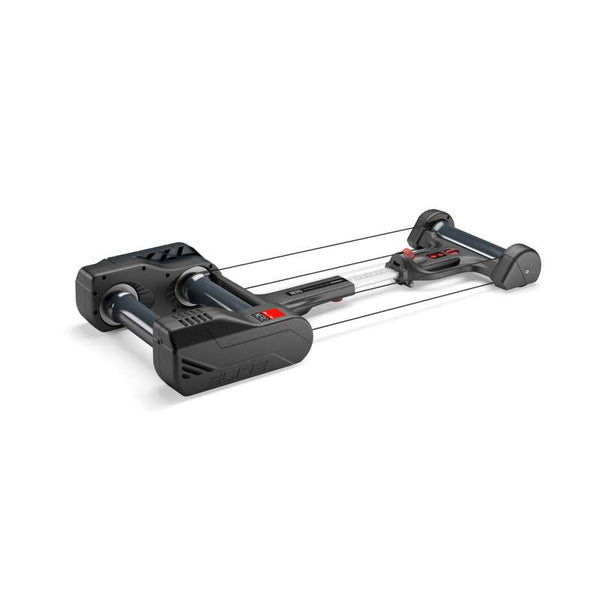
Your needs, this model
Does it fit your priorities?
Does Nero hold the bicycle upright like a wheel-on frame?
No. Nero is a free-standing roller set: both wheels ride on three drums and the bicycle is not clamped at the rear axle. Its floating frame and parabolic rollers are design features, but the rider must still balance and steer the bike.
Explore this need in the finder →Can a compatible app control Nero's resistance?
Yes. Elite documents an electronically controlled magnetic brake with ANT+ FE-C and Bluetooth FTMS, and a maximum simulated grade of 7%. This supports an interactive roller plan but does not establish that every training app, device or workout exposes the same control.
Explore this need in the finder →Will Nero fit my bicycle's wheelbase?
Measure the distance between the front and rear axle centers. Elite lists eleven front-roller positions covering 944–1,144 mm; its technical sheet also lists a 110 kg maximum load. Confirm the exact model instructions, frame geometry, tires and how the load limit applies before ordering.
Explore this need in the finder →Does Nero need a cassette or a separate power supply?
The U.S. Nero offer is a roller format: the bicycle keeps its rear wheel and drivetrain, so there is no trainer cassette or Zwift Cog/Click package. Elite specifies a power supply for the electronically controlled brake; check the exact U.S. box and wall-power requirements with the seller.
Explore this need in the finder →What does Nero's 7% claim tell me?
Elite's documented simulated-grade maximum is 7%, so a finder minimum of 7% includes Nero and an 8% minimum excludes it. That is a manufacturer specification, not independent testing, an actual route gradient, or an assurance for a particular rider and bicycle.
Explore this need in the finder →Elite Nero combines free-standing rollers with an electronically controlled magnetic brake. That gives it a less common position in the trainer field: it can respond to compatible training software, but it does not clamp the bicycle at the rear axle or remove the rider's need to balance. A shopper wanting automatic resistance and a familiar fixed-frame setup should not treat “smart” as proof that Nero handles like a wheel-on or direct-drive trainer.
Interactive braking on an unrestrained bicycle
The Nero frame supports three drums under the front and rear wheels; the bike stays assembled and can move rather than being fastened at its axle. Elite describes a floating section that yields slightly fore and aft, parabolic drum ends, and two rear flywheels of 2.7 kg each. An integrated step is intended to help with mounting. These are substantial design differences from basic free-standing rollers, but they do not remove the balance and steering task. Plan a clear, level area and do not assume a smart resistance feature makes mounting or stopping hands-free.
Elite identifies the brake as electronically controlled and lists ANT+ FE-C and Bluetooth FTMS connectivity. Its current page says compatible software can adjust resistance during a session up to a 7% simulated grade. That makes Nero a real app-controlled roller rather than a manual trainer with only a speed sensor. Still, the stated protocols do not guarantee that every app, computer, firmware version or workout exposes every control mode; check the exact software and device combination you plan to use.
The maker's 2025 sheet lists 270 W at 20 km/h and 760 W at 40 km/h. Those are speed-dependent resistance specifications, not an independent power test. Elite lists power, speed and cadence data but identifies power as estimated; no integrated power-meter accuracy percentage is documented. The 7% figure describes the trainer's published simulated-grade ceiling, not a promise that a particular route or rider will feel like climbing a real 7% hill.
Fit, support and operating checks
Elite lists eleven front-roller positions across a 944–1,144 mm bicycle wheelbase. Measure from axle center to axle center on the bicycle you will use and verify the exact instructions, rather than inferring fit from wheel size or frame category. The product page includes road, gravel, mountain and city bikes in its compatibility list, but that broad list does not replace checking tire, frame and use restrictions. Elite also lists a 110 kg maximum supported load. Ask how the manufacturer applies that limit to rider and bicycle together.
The technical sheet gives an open footprint of about 1,400 × 630 × 204 mm and a folded size of 630 × 470 × 304 mm. The trainer is listed at 18 kg and folds into three sections. Allow more floor area than the folded dimensions: a rider needs room to get on, hold balance, and step away. The supplied power adapter is part of the electrically controlled arrangement, so the space also needs a suitable outlet and a cable route that does not cross a walking path.
Package identity and limits
The U.S. importer lists a Nero Interactive Roller with model code 0182001EXUE and Todson SKU 110182001EXUE. Elite's 2026 catalogue lists the global Nero MPN 0182001; the suffix on the U.S. importer listing is retained as a regional offer code, not treated as a second trainer. The importer page states that a 12-month My E-Training subscription is included, and Elite's Nero sheet gives the same term. The exact page is useful for identity, but it does not prove future availability or enumerate every carton item.
Nero is a roller arrangement, so the bicycle retains its own rear wheel and drivetrain. There is no trainer cassette or Zwift Cog-and-Click setup to match to the bike's speeds; make sure the retailer's box is the exact U.S. version and confirm any included power supply or subscription terms before purchase. The manufacturer's stated maximum grade is 7%, lower than the published limits of many current smart direct-drive trainers. If high simulated climbing is a hard constraint, compare the grade field before making the roller format the priority.
Why the difference from Quick-Motion matters
Nero and Elite Quick-Motion both use free-standing drums, floating-frame ideas and the same documented 944–1,144 mm wheelbase interval. Quick-Motion has three manually selected magnetic levels and optional Misuro B+ data; it does not automatically change resistance. Nero replaces that manual resistance arrangement with an app-controlled electronic brake and adds the stated grade simulation and paired flywheels. The trade is not “smart versus stable”: both require a rider to balance on rollers. Read the separate Quick-Motion assessment if the lower-complexity manual option is more suitable, and compare Arion Mag when you specifically want three manual magnetic levels without Nero's electronic brake.
Who should shortlist Nero?
Nero is worth investigating when a rider deliberately wants free movement on drums while also wanting app-led resistance changes. It is a poor substitute for a clamped trainer if the rider needs the bicycle held in place, and it may not satisfy a high-grade requirement. Before buying, confirm the exact U.S. model code and package, wheelbase, tire compatibility, load interpretation, app/device support, power requirements and any subscription registration. No article claim here is based on hands-on riding, measured noise, independent grade or power tests, or customer experience; it follows the cited manufacturer and importer material.
Key specifications
Key details at a glance
| Trainer setup | Rollers |
|---|---|
| App-controlled resistance | Yes |
| Manufacturer maximum resistance power | 760 W |
| Maximum simulated uphill grade | 7% |
| Cassette included in reviewed package | No |
| Zwift Cog and Click included in reviewed package | No |
| Listed connection protocols | ANT+ FE-C / Bluetooth FTMS |
| Listed ride metrics | estimated power / speed / cadence |
| AC power adapter included | Yes |
| Mains power required for powered resistance | Yes |
| Manufacturer maximum load | 110 kg |
Use the exact model’s instructions for operating limits, supplied equipment and version differences.
Sources for this review
Sources for this assessment
See how this setup fits your own priorities.
The finder uses documented setup and feature differences. It is not a compatibility guarantee; verify your exact frame, drivetrain and supplied package.