
Your needs, this model
Does it fit your priorities?
Does standard Arion hold the bicycle upright at the rear axle?
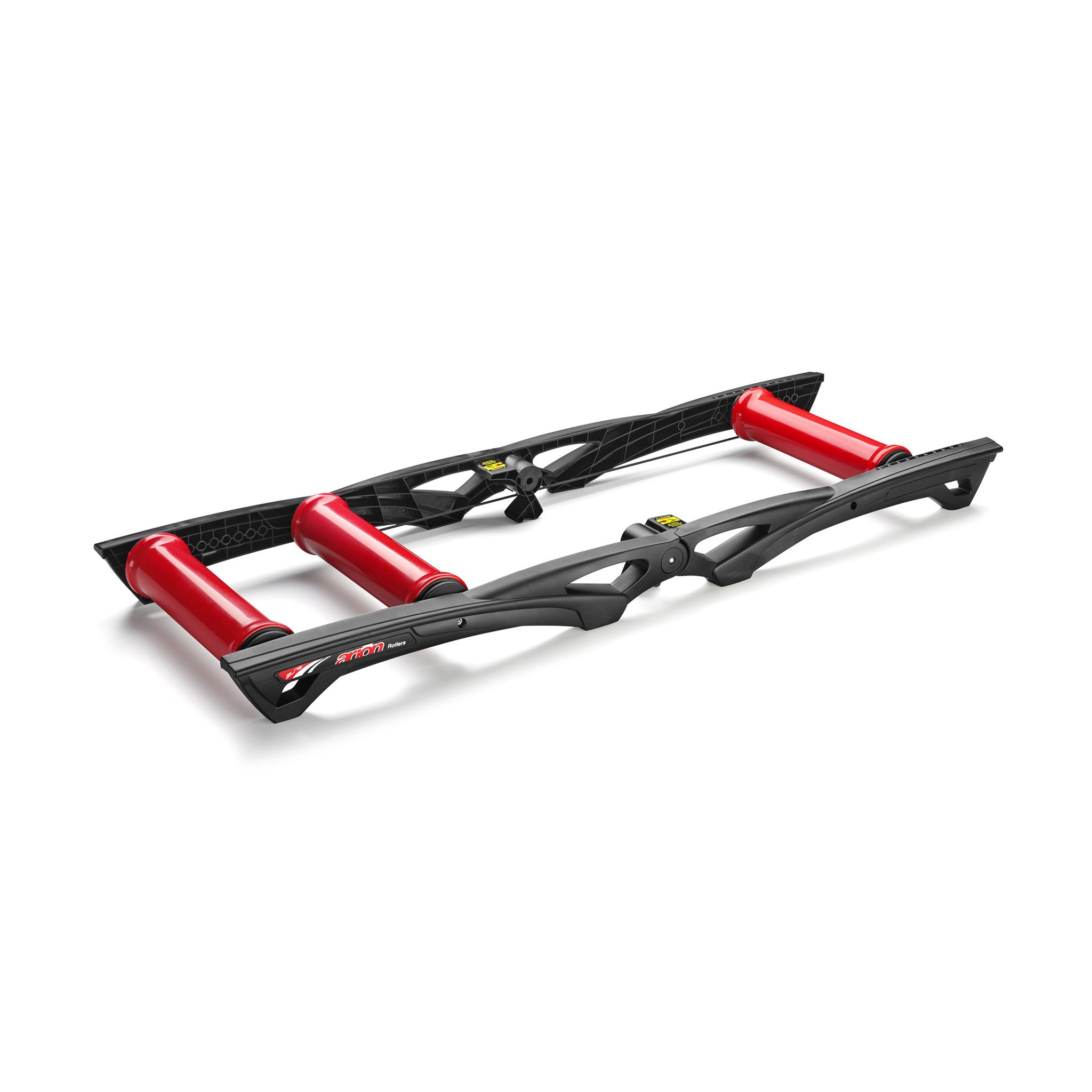
No. Standard Arion supports the assembled bicycle on three free-standing drums; you balance it instead of fastening the rear axle to a trainer. Its parabolic drum ends and integrated step are design features, not a rear-wheel clamp.
Explore this need in the finder →Can a training app automatically change Arion's resistance?
No supported automatic resistance-control arrangement is documented. Elite's current page lists zero resistance levels and no resistance type; the optional Misuro B+ is described for speed, cadence and estimated app power, not brake control. The linked technical sheet's different ‘Magnetic roller’ wording does not describe an app-controlled brake.
Explore this need in the finder →How do I check whether my bicycle fits the standard Arion rollers?
Measure its wheelbase between the two wheel axles and compare that measurement with Elite's stated 944–1,124 mm range, which uses ten front-roller positions. Elite also lists a 110 kg maximum load; check its current instructions for how that limit applies to your exact setup.
Explore this need in the finder →Does the Arion roller package need a trainer cassette or Zwift Cog?
No trainer cassette or Cog setup is documented for standard Arion: the bicycle stays assembled with its own rear wheel and drivetrain on the rollers. Todson's listing does not enumerate every box item, so confirm whether the optional Misuro B+ sensor is included if you want app data.
Explore this need in the finder →What maximum power should I use when comparing standard Arion?
The manufacturer sources disagree: Elite's live page and the Todson offer state 280 W at 40 km/h, while the linked Elite technical sheet states 520 W at 40 km/h and 220 W at 20 km/h; Todson lists 130 W at 20 km/h. The sources do not reconcile those figures, so this assessment does not choose one as a reliable comparison rating.
Explore this need in the finder →Elite Arion (manufacturer MPN 0100501; official U.S. importer SKU 110100501) is a free-standing roller set for riding an assembled bicycle on three moving drums. It does not hold the bicycle at its rear axle, and the current Elite product page lists zero resistance levels and no resistance type. This is a research-based assessment of the manufacturer and importer records, not a ride test, ownership report or claim about how stable the rollers feel to a particular rider.
Choose the free-standing format deliberately
On Arion, the bike's front and rear wheels rest on the rollers while the rider balances and steers. There is no rear-wheel clamp or direct-drive axle attachment. Elite describes the drums as parabolic, with a narrower middle and wider ends intended to guide the wheels toward the center. That geometry is a design aid, not a frame restraint: the bicycle remains free to move, so plan a clear area for mounting, riding and stopping. If you want the rear wheel held in a fixed wheel-on frame, compare the Elite Novo Force or Wahoo KICKR ROLLR. They support the bicycle differently and are not variants of Arion.
Arion's three drums are specified as 85 mm across the center and 100 mm at the ends. The front drum adjusts across ten positions to fit a stated wheelbase from 944 to 1,124 mm. Measure axle-center to axle-center on the bicycle you intend to use; broad labels such as road, gravel, mountain or city do not establish that it falls in the published range. The product page lists a 110 kg maximum load. It does not explain in the material reviewed how that limit should be apportioned between rider and bicycle, so check the manufacturer's current instructions if you are near it.
Standard Arion is not Arion Mag
Names are easy to confuse here. Standard Arion is MPN 0100501; Arion Mag is a separate MPN 0100550 roller with a manually selected magnetic-resistance unit. Elite's current standard-Arion product page lists zero resistance levels and “No” for resistance type, and the standard page does not describe a manual brake selector. Its linked technical sheet uses the phrase “Magnetic roller” in the home-trainer-type row, so the documents do not use wholly consistent terminology. That phrase is not enough evidence to assign Arion the Mag model's three selectable resistance levels. The useful buying distinction is that the current product page documents no selectable resistance on standard Arion, whereas Arion Mag explicitly specifies three manual levels.
Sensor data are not automatic resistance control
Elite says the optional Misuro B+ sensor can transmit speed and cadence over ANT+ and Bluetooth Smart, with estimated power available through My E-Training. That is a data-reporting path, not an electronically controlled brake: a compatible training app does not thereby gain the ability to make Arion follow a virtual climb or automatically change a resistance level. No integrated power meter is listed, and the U.S. importer's product page does not identify a Misuro B+ sensor among package contents. Treat the sensor as a separate item unless the exact seller's box description says otherwise. Elite lists one month of My E-Training access with the trainer; verify the current subscription terms and any app requirements before relying on them.
Do not compare the conflicting output figures as a test result
The U.S. importer and Elite's live product page give a 280 W figure at 40 km/h; the importer also lists 130 W at 20 km/h. The linked Elite technical sheet instead lists 220 W at 20 km/h and 520 W at 40 km/h. Those are incompatible manufacturer-published figures for the same MPN. The sources do not explain the difference, so this assessment does not choose a number or use it to rank Arion's workload range. None is an independent measurement, a rider-specific power result or a simulated-grade rating. Elite publishes no maximum simulated uphill grade for this model in the material checked; an unknown grade does not meet a numeric minimum in the finder.
Folding helps storage, but not room clearance
Elite lists open dimensions of 1,400 × 500 × 130 mm, folded dimensions of 730 × 530 × 250 mm and a trainer weight of 7.8 kg. Those figures help compare storage and carrying, but folded size is not a safe operating footprint. Leave room around the bicycle and rider for mounting, handlebars, movement and a controlled dismount. The technical sheet says there is no power supply, so the roller set does not need an AC outlet for its basic operation. The bicycle keeps its own rear wheel and cassette; Arion is not a trainer-cassette or Zwift Cog package.
What the U.S. offer establishes—and what to check
Todson identifies itself as Elite's official U.S. representative and lists “Arion Classic Roller” with manufacturer SKU 0100501 and Todson SKU 110100501. This confirms a U.S.-market offer record for the standard model, not present stock or future availability. Its page describes sensor-dependent app data but does not provide a detailed in-box list. Before ordering, confirm that the listing is the standard three-drum Arion and not Arion Mag, check the exact wheelbase and published load limit, and ask whether any sensor is actually included. If automatic resistance, a known climbing simulation figure or a bicycle held upright is essential, the standard Arion evidence does not establish those capabilities; use the finder to compare a different supported format.
Arion is most relevant to someone intentionally seeking free-standing rollers and comfortable balancing an unrestrained bicycle. The parabolic drums, adjustable front position and foldable frame are documented design features; they are not a guarantee of easy first use or bike fit. No hands-on use, noise measurement, ownership, independent power testing, customer experience, current-stock check or retailer price comparison is claimed here.
Key specifications
Key details at a glance
| Trainer setup | Rollers |
|---|---|
| App-controlled resistance | No |
| Cassette included in reviewed package | No |
| Zwift Cog and Click included in reviewed package | No |
| Listed connection protocols | ANT+ (optional Misuro B+) / Bluetooth Smart (optional Misuro B+) |
| AC power adapter included | No |
| Mains power required for powered resistance | No |
| Manual resistance levels | 0 levels |
| Manufacturer maximum load | 110 kg |
Use the exact model’s instructions for operating limits, supplied equipment and version differences.
Sources for this review
Sources for this assessment
See how this setup fits your own priorities.
The finder uses documented setup and feature differences. It is not a compatibility guarantee; verify your exact frame, drivetrain and supplied package.