
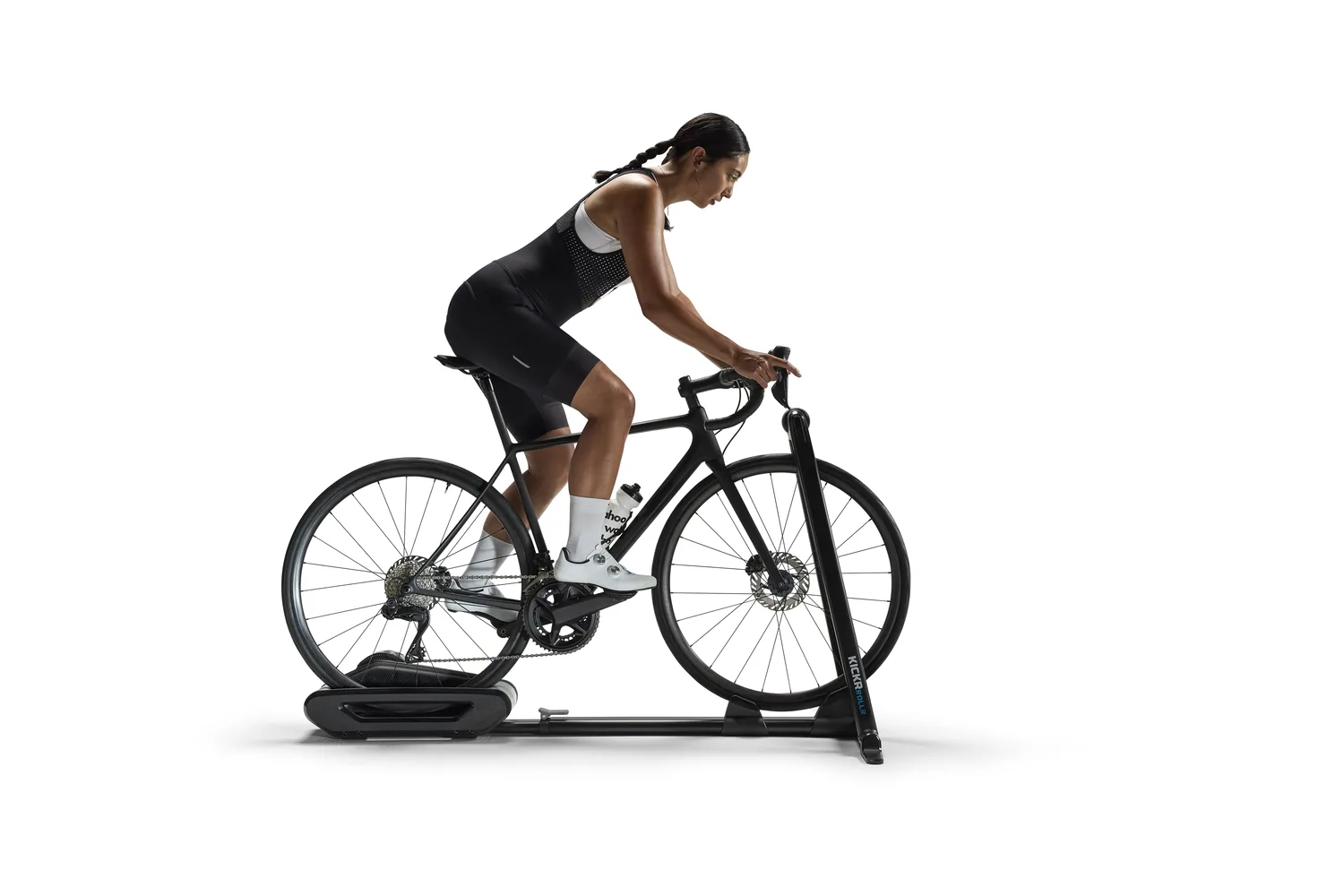
Your needs, this model
Does it fit your priorities?
Does my rear wheel stay on the KICKR ROLLR?
Yes. Wahoo's adjustable rear roller supports the tire with the wheel installed, while a front tire gripper stabilizes the bike. That avoids a trainer cassette and axle mounting, but it is not the same setup as a direct-drive unit or a conventional pair of free-standing rollers.
Explore this need in the finder →Can an app change the ROLLR's resistance during a workout?
Wahoo identifies the ROLLR as a smart trainer with electromagnetic resistance and documents use with compatible training applications. The trainer needs its AC adapter for powered resistance; app, device, connection method and workout support still need to be checked.
Explore this need in the finder →Is KICKR ROLLR a free-balancing roller trainer?
No. Its front tire is held by a stabilizer arm, so it is categorized here as a wheel-on supported-bike trainer, not a free-standing rollers setup. If practicing balance on open drums is the goal, compare a true roller set instead.
Explore this need in the finder →The Wahoo KICKR ROLLR is easiest to understand by separating its name from its setup. It is a smart, powered trainer that uses two rear rollers and a front-tire stabilizer; the bicycle's rear wheel stays on. That makes it a wheel-on choice in this comparison, not a direct-drive trainer and not an open set of rollers that asks the rider to balance. This source-based assessment suits someone who wants to move a compatible bike indoors without removing its wheel and still use app-controlled resistance. It is not a universal bicycle-fit claim or a hands-on ride report.
A wheel-on setup with more support than free rollers
To set up the ROLLR, Wahoo's instructions describe aligning the bike's wheelbase with the adjustable trainer, seating the front tire in its gripper and placing the rear tire on the resistance rollers. You avoid a cassette swap, rear-axle adapters and the wheel-off routine required by the KICKR v6 or CORE. In return, the bicycle's tires remain part of the contact system: Wahoo recommends a smooth tread and notes that knobby tires can wear faster and feel more turbulent. This is a useful distinction for a rider comparing all three indoor formats. A direct-drive model removes the rear wheel; conventional rollers support both wheels on drums without the ROLLR's front stabilizing arm.
Don't rely on the phrase “almost any bike” on a product page. Wahoo's bicycle-compatibility article, updated October 24, 2026, gives a 950–1100 mm wheelbase, a 700c wheel and a tire limit of 1.8 in / 45 mm. It lists non-700c wheels, wheelbases outside that range and larger tires as incompatible. The product page separately says the front gripper supports up to 2.1 in / 53 mm. Because those figures conflict, this assessment uses the stricter support-page limit and treats a wider tire as unverified until Wahoo confirms it for the exact bicycle. Wahoo also warns that matching the listed dimensions does not guarantee a particular frame is safe or compatible. Measure the bike, check its tire and wheel size, and ask a Wahoo retailer about uncertain frame fit before ordering.
Smart control without a published accuracy percentage
Wahoo lists electromagnetic resistance, a maximum output of 1,500 watts and a maximum simulated uphill grade of 10 percent. Those are manufacturer limits, not measured results in this review. Wahoo documents the ROLLR with connected training applications and identifies it as a smart trainer, so compatible software can control resistance for supported workouts. The trainer needs its supplied AC adapter for powered operation; pairing a phone alone does not replace mains power.
Power reporting is a more nuanced trade-off. Wahoo says the ROLLR can use its onboard power estimate or connect to an external ANT+ power meter. Its product page calls onboard power approximate, and the support FAQ says accuracy depends on an on-bike meter or consistent use of the same bicycle. It does not give a single percent-accuracy figure for the ROLLR. The trainer also does not provide cadence data by itself; Wahoo says to add a cadence sensor or power meter if cadence is needed. If your priority is independently reported power or comparing a number precisely across bikes, a paired power meter or a direct-drive trainer with a stated accuracy specification is a better starting point.
For context, the cassette-equipped KICKR v6 is a wheel-off direct-drive machine with Wahoo's higher published power and grade limits and a stated ±1% accuracy. The ROLLR trades those particular ceilings for a rear-wheel-on mounting routine. Its relatively large, adjustable frame and 50 lb manufacturer-listed unboxed weight also make room planning sensible; check the dimensions and leave clearance for getting the bike on and off. This comparison describes specifications, not a claim that one design feels better under a rider.
Who should shortlist it—and who should not
Choose the ROLLR for further comparison if you have a 700c bike inside Wahoo's fit limits, prefer leaving its rear wheel and drivetrain assembled, and want app-controlled resistance with a front support that makes mounting less like balancing on classic rollers. It can be a practical fit when several riders use their own compatible bicycles, but each bike still needs its own wheelbase, tire and frame check. A power meter is optional for the ROLLR's onboard power mode, but it is relevant if your training depends on more accurate external power data. Wahoo's onboard-power instructions describe the app pairing and firmware requirements.
Compare direct drive instead if you want the wheel removed, a cassette mounted to the trainer, or a published power-accuracy figure. Compare traditional rollers if practicing balance is the purpose. Do not treat the 10% grade figure as an incline guarantee for every app or rider; it is the manufacturer's simulated limit, and the chosen software must support the relevant trainer mode. Before purchase, confirm the current box contents, adapter, support limit for your tire, the exact bicycle's fit, app compatibility and the availability of an outlet. Wahoo's US product listing identifies the trainer as part WFBKTR9B. This review interprets Wahoo's catalog and support materials; it does not claim ownership, testing, setup, measured noise, measured power or customer experience.
Key specifications
Key details at a glance
| Trainer setup | Wheel-on / rear tire on |
|---|---|
| App-controlled resistance | Yes |
| Manufacturer maximum resistance power | 1500 W |
| Maximum simulated uphill grade | 10% |
| Maximum simulated downhill grade | -10% |
| Cassette included in reviewed package | No |
| Zwift Cog and Click included in reviewed package | No |
| Listed connection protocols | ANT+ / ANT+ FE-C / Bluetooth / Direct Connect |
| Listed ride metrics | speed / distance / approximate power |
| Manufacturer maximum rider weight | 250 lb |
| AC power adapter included | Yes |
| Mains power required for powered resistance | Yes |
Use the exact model’s instructions for operating limits, supplied equipment and version differences.
Sources for this review
Sources for this assessment
- Shop Bike Trainers | Wahoo Fitness
- KICKR ROLLR Smart Bike Roller Trainer | Wahoo Fitness
- KICKR ROLLR Product Information & FAQ | Wahoo Fitness Support
- KICKR ROLLR Bicycle Compatibility | Wahoo Fitness Support
- Use a KICKR ROLLR with onboard power | Wahoo Fitness Support
- Identify a KICKR trainer | Wahoo Fitness Support
See how this setup fits your own priorities.
The finder uses documented setup and feature differences. It is not a compatibility guarantee; verify your exact frame, drivetrain and supplied package.