
Your needs, this model
Does it fit your priorities?
Can I keep the rear wheel on the bike with Novo Force?
Yes. Elite identifies Novo Force as wheel-on: the rear tire stays on the bicycle and contacts the trainer roller. Confirm the exact tire, wheel, frame and axle fit before setup.
Explore this need in the finder →Does an app automatically change Novo Force's resistance?
No automatic resistance control is documented. Elite describes eight magnetic resistance levels selected from the handlebar. An optional Misuro B+ sensor can transmit training data, but it does not turn this manual trainer into an app-controlled resistance model.
Explore this need in the finder →Does this trainer include a cassette or Zwift Cog and Click?
Novo Force is wheel-on, so the bicycle keeps its own rear wheel and cassette; the trainer base is not supplied with a trainer cassette or Zwift Cog and Click. Verify the exact package and any optional sensor separately.
Explore this need in the finder →What wheel and axle fit does Elite document?
The current Elite page lists 24–29 inch wheels and includes 130–135 mm quick-release adapters. It lists several thru-axle options as separately available; confirm the exact adapter, tire clearance and rear-frame width for your bicycle.
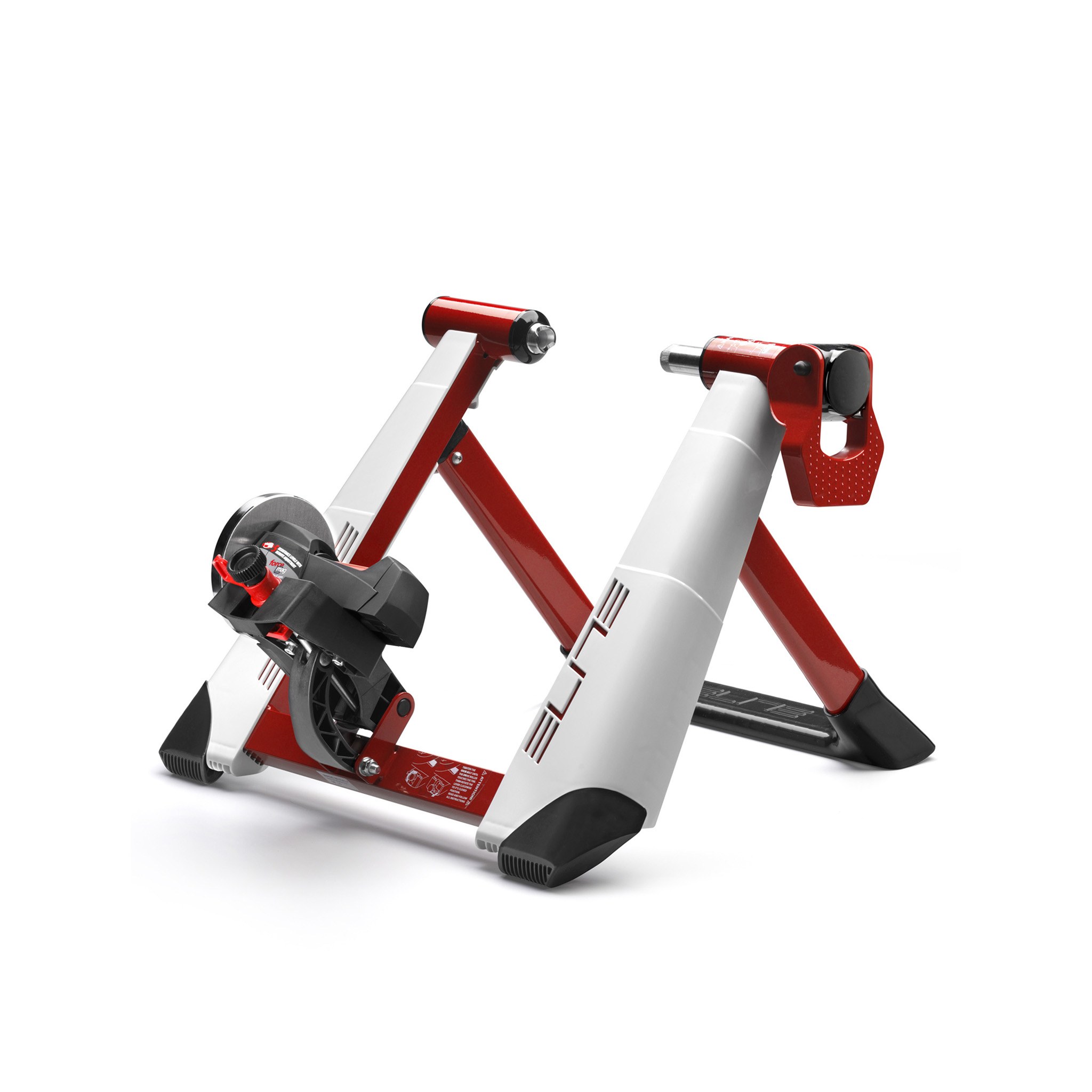
Explore this need in the finder →The Novo Force is Elite’s manually controlled, wheel-on magnetic trainer, with the bike’s rear tire pressing against its resistance roller. Elite lists eight resistance levels selected from a handlebar control, 24–29-inch wheel compatibility and a foldable frame. In the United States, the official importer identifies this model as MPN 0111303 (Todson SKU 110111303); its collection showed the entry sold out when checked October 29, 2026. That is a dated observation, not a stock forecast. This assessment is based on manufacturer and importer documentation, not an assembly, ride or noise test.
A basic rear-wheel-on arrangement
With Novo Force, the bicycle remains on its own rear wheel. Elite describes a magnetic roller unit and a quick-fixing rear-axle frame, rather than a cassette-mounted freehub. That makes the first decision simple: do you want to keep the rear wheel installed, and are you comfortable with the tire-to-roller contact? This differs from Elite’s direct-drive Justo 2, which removes the rear wheel, and from its Tuo smart wheel-on model, which can change resistance electronically from supported training software. Novo Force is the deliberate manual option: the rider selects among eight levels using a handlebar control.
The standard wheel-on setup does not use a trainer cassette or Zwift Cog and Click. Your bicycle keeps its own rear wheel and gearing. The inclusion of a trainer cassette is therefore not the attraction here; the useful distinction is that you do not remove the wheel or install a cassette on the trainer. If you need resistance to change automatically during a virtual route or ERG workout, this model does not document that function. A sensor can add ride data, but it does not convert the manual resistance selector into an app-controlled brake.
Manual resistance is not the same as smart training
Elite says Novo Force has eight magnetic settings, selected by the handlebar control. Its technical sheet lists no power supply. Elite separately describes the Misuro B+ sensor as an optional addition that can transmit speed and cadence by ANT+ or Bluetooth Smart and provide estimated-power data in My E-Training. The sensor is not the resistance control: the levels remain manually selected. Nor is estimated power from that optional path an integrated power meter or an independently verified accuracy result.
The technical sheet gives a maximum power figure of 690 watts at 40 km/h and 300 watts at 20 km/h. These are manufacturer figures for a speed-related resistance specification, not a wattage test and not a promise that every rider can reach those loads. Elite does not state a simulated-grade percentage for Novo Force, so it should not be treated as a match when a documented minimum incline rating is essential. A month of My E-Training is listed, but the product page’s sensor instructions still matter: the app offer does not establish that a telemetry sensor is included.
Fit checks before choosing a wheel-on trainer
Elite’s current product page lists 24–29-inch wheels and includes a 130–135 mm quick-release adapter. It lists several thru-axle and specialty interfaces as separately available adapters, including 12 × 142 mm, 10 × 135–12 × 135 mm, Specialized SCS and Boost. For Boost, Elite gives a maximum external rear-triangle width of 175.4 mm. Check the exact bike’s axle, frame shape, tire clearance and wheel dimensions against the current instructions; a broad wheel-size range does not guarantee every frame or tire fit.
The manufacturer lists an 8 kg trainer, a foldable frame and a maximum load of 110 kg. Confirm how Elite defines that load limit in its current documentation before relying on it for your rider-and-bike combination. The optional axle adapters should not be mistaken for included accessories. Elite’s product page also says an Elastogel roller can reduce noise by 50% and tire wear by up to 20%; those are manufacturer comparisons, not measurements from this review or a guarantee for your tire, pressure, room or session.
Who may prefer the manual format?
Novo Force makes sense on paper for someone who wants resistance without a powered trainer, automatic software control or a trainer cassette, and who is content to adjust effort at the handlebar. It can support a simple indoor ride without a phone or app connection. If session data matters, budget for the optional sensor or an external power source and verify the exact data route. If you want route-driven resistance, a higher published simulated-grade limit, or built-in power measurement, compare it with documented smart direct-drive trainers instead.
Against another wheel-on choice, the important contrast is not a claim that one rides more quietly or feels better. A smart wheel-on trainer like Elite Tuo retains the rear wheel but documents app-controlled resistance; Novo Force uses manual levels and no power supply. Direct-drive trainers change the mounting job and the supplied drivetrain package. Choose based on what your routine actually needs, then verify the exact listing, seller status and box contents before buying. The US importer’s dated sold-out display means this assessment does not imply availability. No personal ownership, setup, ride, measured noise, tire-wear or power-testing experience is claimed.
Key specifications
Key details at a glance
| Trainer setup | Wheel-on / rear tire on |
|---|---|
| App-controlled resistance | No |
| Manufacturer maximum resistance power | 690 W |
| Cassette included in reviewed package | No |
| Zwift Cog and Click included in reviewed package | No |
| Listed connection protocols | |
| AC power adapter included | No |
| Mains power required for powered resistance | No |
| Manual resistance levels | 8 levels |
| Manufacturer maximum load | 110 kg |
Use the exact model’s instructions for operating limits, supplied equipment and version differences.
Sources for this review
Sources for this assessment
See how this setup fits your own priorities.
The finder uses documented setup and feature differences. It is not a compatibility guarantee; verify your exact frame, drivetrain and supplied package.