
Your needs, this model
Does it fit your priorities?
Will Galaxia hold the bicycle upright like a wheel-on frame?
No. Garmin describes a free-standing roller setup: the wheels ride on three drums and the rider balances the unrestrained bicycle. The swing frame is described as absorbing sudden movement, not as an axle clamp or a guarantee against a wheel leaving the rollers. Practice in a clear area and follow the manual's first-ride instructions.
Explore this need in the finder →Can an app change Galaxia's resistance automatically?
The reviewed manufacturer sources describe a mechanical roller and swing frame, not an electronic brake or app-controlled resistance plan. Its optional-looking data or a compatible cycling app would not by itself establish automatic resistance; no sensor inclusion is documented here.
Explore this need in the finder →Does the setup need a trainer cassette, and what bicycle dimension should I check?
Galaxia supports the assembled bike on its own wheels, so the bike's rear wheel and cassette stay in place; no trainer cassette or Cog/Click package is documented. Garmin's manual asks the rider to measure axle-to-axle length and set one of seven positions. Its table has six bands from 980 to 1,100 mm and a seventh for less than 980 mm, without stating that final position's lower endpoint.
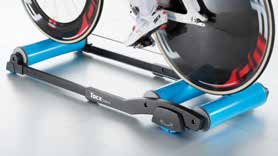
Explore this need in the finder →The Tacx Galaxia is a free-standing roller trainer for riding an assembled bicycle on moving drums. Garmin's U.S. category lists the Galaxia Advanced Roller Trainer, while its manufacturer parts material identifies the model family as T1100. That model number is not an established U.S. retail SKU, and the evidence reviewed does not establish a current seller, complete retail box or stock. This is a source-based assessment of the documented design, not a ride test or an ownership report.
Choose balance-on-drums rather than a frame clamp
Galaxia supports the bicycle under its front and rear wheels. It does not attach the frame to a rear axle as a direct-drive trainer does, and it does not clamp the rear wheel in a fixed support frame as a conventional wheel-on unit does. The bicycle remains free to move while its wheels roll over three drums. Garmin's quick-start instructions say the first ride should be short, on a flat, unobstructed surface; they recommend getting used to balance near a doorway or wall, looking forward rather than down at the front wheel, and reducing speed gradually rather than braking on the rollers. Those instructions matter more than a product name's “advanced” label: this is a balance-based setup, not a trainer that holds the bicycle upright for you.
The swing frame is the distinguishing feature
Garmin describes Galaxia's patented swing system as absorbing sudden movement from sprinting or changes in pace, with the aim of helping the bike avoid derailing. The model-specific parts sheet shows Galaxia's separate swing components, and Garmin's guide says the frame retracts for storage. These are useful design differences from a fixed basic roller, but neither source provides an independent test or promises that a wheel cannot leave the drums. The rider still balances and steers the bicycle. If that unrestrained format is not the workout you intend, compare a framed option such as the KICKR ROLLR or a smart wheel-on trainer such as Elite Tuo; their rear-wheel support is different, not an equivalent stability claim.
Measure wheelbase before setting the frame
The Garmin manual does not ask you to guess from a broad road-bike or mountain-bike label. It instructs you to measure from axle to axle and adjust the spring holders and dowel pins to one of seven positions. Six adjacent bands cover 980–1,100 mm in 20 mm steps; position seven is described only as less than 980 mm, with no lower endpoint stated. Repeat the adjustment when you change bicycles. This chart is a setup guide, not a guarantee that every frame, wheel, tire or rider is suitable. If your measurement falls at a boundary, follow the current manual rather than assuming the neighboring position is interchangeable.
Galaxia and Antares are separate roller designs
The U.S. Garmin category also names the Tacx Antares Basic Trainer, and the manufacturer treats the two as separate products: the parts material identifies Galaxia T1100, while Garmin's regional Antares product page identifies T1000. Garmin's buyer guide assigns the swing system to Galaxia and describes Antares as a basic roller without that system, using conical rollers. That comparison explains why the names should not be collapsed into a single product. The U.S. Antares retail package, exact U.S. seller identifier and current availability remain unresolved in this library, so this assessment does not present Antares as a reviewed U.S. alternative or infer its box from Galaxia's parts sheet.
Do not mistake roller use for app-controlled resistance
The checked Galaxia materials describe mechanical drums, a belt, a retractable frame and the adjustment hardware. They do not document an electronic brake, a resistance selector, an integrated power meter, communications or a speed sensor in the box. An app name appearing elsewhere in a Garmin cycling guide would not establish that this model changes resistance in response to software. For the questionnaire's non-smart choice, that distinction matters: a sensor that reports speed would be data collection, not automatic resistance control. The current sources also publish no simulated uphill-grade percentage. The numeric finder therefore treats grade as unknown, even at a zero-percent minimum; it is not reasonable to convert “roller” or “advanced” into a climbing specification.
Check the exact offer and the room around the bike
The exact U.S. Garmin category and product-route labels establish Galaxia as an observed U.S.-listed model, but I could not verify a U.S. retail SKU, complete box inventory, current price or stock. The T1100 identifier appears in Garmin's regional product material and manufacturer parts sheet; do not assume it is the seller's U.S. part number. Before buying, ask for the exact model and package, confirm that the supplied frame, rollers, belt and adjustment hardware are complete, and measure your bicycle axle-to-axle against the manual. Leave a clear practice and stopping area. Garmin's roller manual says not to place the rollers on a mat, so check that instruction before using a floor covering intended for a fixed trainer. A product photograph is not evidence of included parts or fit.
Galaxia is best considered by someone specifically seeking balance-based rollers and the swing-frame design, who accepts the practice and clearance requirements. The sources support that design intent, not a claim that it is easier, safer, quieter or faster than another roller. No hands-on use, measured stability, sound test, individual bicycle fit, customer experience or current seller availability is claimed.
Key specifications
Key details at a glance
Use the exact model’s instructions for operating limits, supplied equipment and version differences.
Sources for this review
Sources for this assessment
- Garmin Tacx Indoor Bike Trainers — Garmin U.S.
- Garmin Tacx Galaxia Advanced Roller Trainer — Garmin U.S.
- Tacx Galaxia Advanced Roller Trainer, part T1100 — Garmin U.K.
- Manual Set for Antares Trainer — Garmin U.S.
- Tacx Antares/Galaxia Roller Trainers Quick Start Manual — Garmin
- How to Choose the Best Indoor Bike Trainer for You — Garmin U.S.
- T1100 Galaxia — Garmin/Tacx parts sheet
See how this setup fits your own priorities.
The finder uses documented setup and feature differences. It is not a compatibility guarantee; verify your exact frame, drivetrain and supplied package.