
Your needs, this model
Does it fit your priorities?
Does Antares hold the bicycle at its rear axle?
No. Antares is a three-drum, free-standing roller trainer. The assembled bicycle remains on its own wheels, and the rider balances rather than attaching the frame to a trainer axle or clamp.
Explore this need in the finder →How do I check an Antares roller setup against my bicycle?
Measure the bicycle from axle to axle and compare it with Garmin's stated 980–1,100 mm suitable-wheelbase range. The shared Antares/Galaxia manual shows seven setup positions: six 20 mm bands and a seventh labeled only as less than 980 mm, without publishing that position's lower endpoint. Do not treat the adjustment diagram as a universal frame-fit guarantee.
Explore this need in the finder →Does Antares need a trainer cassette, power outlet or app to change resistance?
The reviewed Antares setup keeps the bicycle's own rear wheel and drivetrain on the drums, so it is not a direct-drive cassette or Cog package. The checked manual describes mechanical rollers and no mains-power step or app-controlled brake. The exact U.S. seller's full box inventory is not listed, so confirm any accessory you expect separately.
Explore this need in the finder →The Garmin Tacx Antares Basic Trainer is a three-drum roller setup for riding an assembled bicycle indoors. Garmin's U.S. category and product readers name the Antares, and a U.S. retailer listing identifies the T1000 model. The exact U.S. seller's complete box inventory and present availability are not established here. This is an assessment of published sources, not a ride test, ownership report or claim about how Antares feels on a particular bicycle.
Know what “roller” means before comparing features
Antares supports the bike at its wheels, not by fastening the frame to a rear axle and not by clamping the rear wheel into a fixed trainer stand. Its three drums turn beneath the front and rear tires; the rider steers and balances an unrestrained bicycle. That makes the basic task different from both direct-drive and conventional wheel-on trainers. If your priority is being held upright while pedaling, Antares is not that arrangement. A free-standing set also leaves the bike's own wheel, cassette and chain in place: there is no trainer-side cassette or Cog/Click setup to install.
Antares is the basic roller, not Galaxia's swing-frame design
Garmin treats Antares and Galaxia as separate models. Garmin's buyer guide describes Antares as a basic roller with conical drums and assigns a swing system to Galaxia. The shared roller manual also labels separate Antares and Galaxia frame pieces. Thus a model name that includes “basic” does not imply a fixed bicycle clamp, while the more elaborate Galaxia frame does not turn the bike into a clamped setup either. The swing feature is a design difference, not evidence from a side-by-side stability test or a promise that a wheel cannot move off the drums. Read the separate Galaxia assessment if that feature is material to your comparison.
Measure the bicycle rather than assuming it fits
Garmin's regional product data report Antares as suitable for a 980–1,100 mm bicycle wheelbase, and list 100–110 mm roller diameters. The shared Antares/Galaxia quick-start manual asks the rider to measure from one axle to the other, then set dowel pins to one of seven positions. It gives six adjoining 20 mm bands spanning 980–1,100 mm and a final position described only as less than 980 mm. No lower endpoint is published for that last setting. These statements should be read together, not stretched into a guarantee for every frame below 980 mm: use Garmin's current instructions and verify your specific bicycle dimensions before riding. The manufacturer reports a maximum open footprint of 1,350 by 470 mm and a folded size of 800 by 470 by 135 mm, so leave operating space beyond the stored dimensions.
Resistance is not an app-controlled workout system
The checked Antares sources describe mechanical rollers, natural tire-on-drum resistance and no electronic brake or selector. They do not document an app pairing that changes resistance, an integrated power meter, an included speed sensor or a simulated uphill-grade maximum. A phone app or sensor used alongside a bike may report speed or estimate effort, but that would not establish automatic trainer resistance. For the finder, Antares therefore belongs to the deliberately non-smart option, not to an app-controlled-resistance shortlist. Its grade field remains unknown; the numerical grade choice does not assume that any unreported capability is zero or positive.
Keep package identity separate from setup assumptions
The exact-model U.S. retailer page labels its listing Antares Basic Trainer and identifies T1000, while Garmin's U.S. readers list Antares as a category model. Those sources establish a U.S.-market observation, not a current stock guarantee, seller-wide package standard or a complete parts inventory. The manual shows how the roller assembly is constructed and adjusted, but its shared Antares/Galaxia parts list includes different frame halves and should not be read as a full retail-box checklist for a particular seller. Ask for the exact T1000 box and any assembly hardware you expect. Do not infer that an accessory, sensor or another Tacx model is included because it appears in a photograph or a related support page.
What the product image does—and does not—show
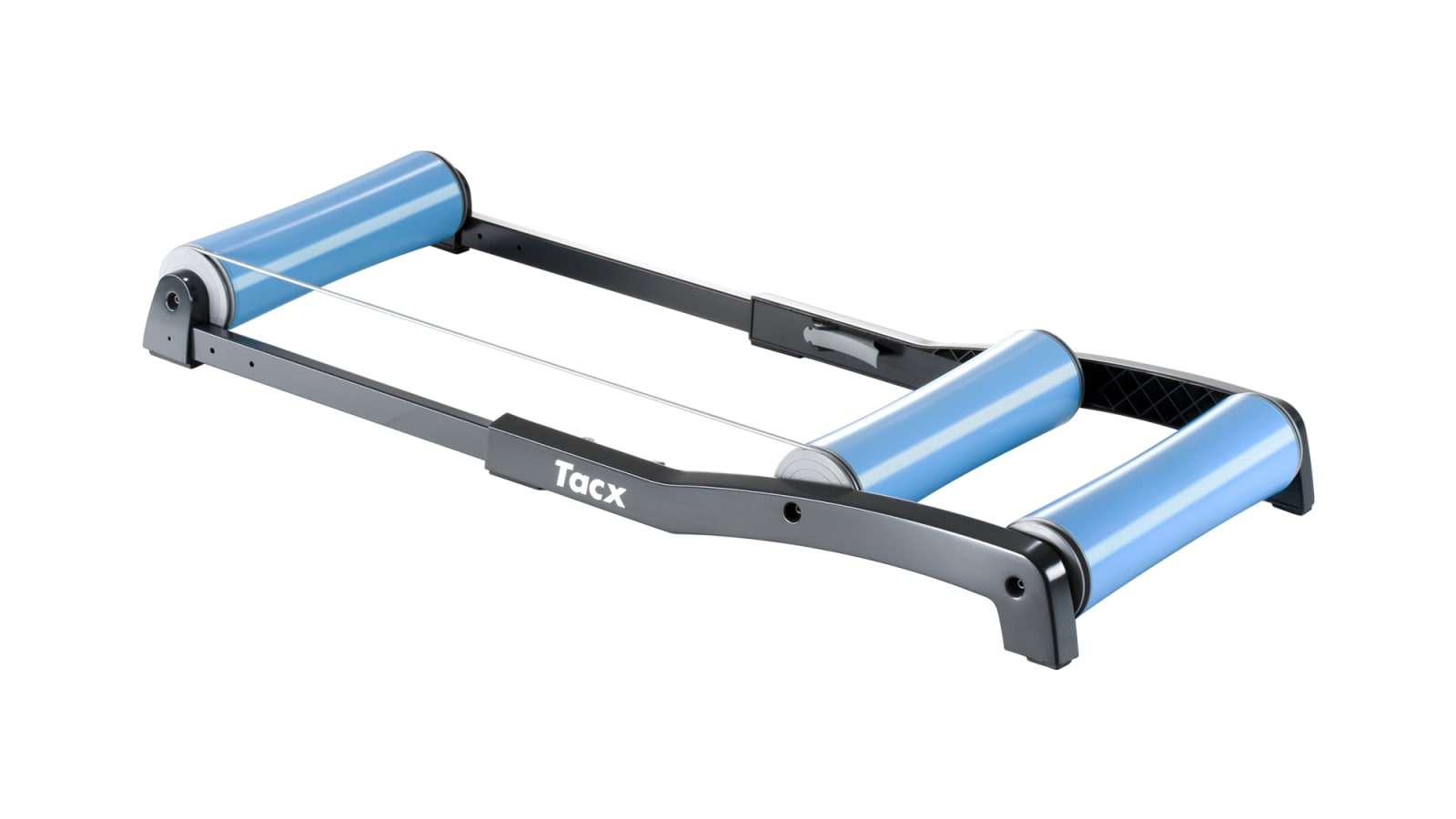
The image used here is the T1000 Antares image attached to the exact U.S. retailer page, rather than a Galaxia image or a generic roller illustration. It shows the three blue drums and the dark, retractable frame. It is a model-identification image, not a view of every part in the box, an installation demonstration, proof of compatibility or evidence of present availability.
Antares is relevant to a buyer who intentionally wants balance-based rollers, can check the bicycle's measured wheelbase and is prepared to practice in a clear space using the manufacturer's safety and setup instructions. The product sources support its geometry and stated fit range; they do not compare actual rider difficulty, stability, noise or training results. No hands-on use, individual bike fit, measured performance, customer experience or current-stock claim is made.
Key specifications
Key details at a glance
| Trainer setup | Rollers |
|---|---|
| App-controlled resistance | No |
| Cassette included in reviewed package | No |
| Zwift Cog and Click included in reviewed package | No |
| Listed connection protocols | |
| AC power adapter included | No |
| Mains power required for powered resistance | No |
Use the exact model’s instructions for operating limits, supplied equipment and version differences.
Sources for this review
Sources for this assessment
- Garmin Tacx Indoor Bike Trainers — Garmin U.S.
- Garmin Tacx Antares Basic Trainer — Garmin U.S.
- Tacx Antares Rollentrainer — Garmin Germany
- Manual Set for Antares Trainer — Garmin U.S.
- Tacx Antares/Galaxia Roller Trainers Quick Start Manual — Garmin
- How to Choose the Best Indoor Bike Trainer for You — Garmin U.S.
- Garmin Tacx Antares Basic Trainer — Rogue Fitness
See how this setup fits your own priorities.
The finder uses documented setup and feature differences. It is not a compatibility guarantee; verify your exact frame, drivetrain and supplied package.