
Your needs, this model
Does it fit your priorities?
Does this trainer control resistance in app-led workouts?
Yes. Wahoo describes automatic resistance control from connected software or routes. The trainer needs its supplied AC power adapter, and the selected app must be connected over a supported protocol. This is a specification-based answer, not a ride test.
Explore this need in the finder →Will I need to buy a cassette before the first ride?
This reviewed version comes with an 11-speed 11-28 Shimano-HG-spaced cassette pre-installed. That saves a separate cassette purchase only if it matches your drivetrain and preferred gear range; Wahoo flags Shimano CUES/LinkGlide as incompatible with the included cassette.
Explore this need in the finder →Can I leave the bike's rear wheel on?
No. This is a direct-drive setup: you remove the rear wheel and mount the frame on the trainer's axle adapters. If you need to keep the rear wheel installed, compare a wheel-on trainer or rollers instead.
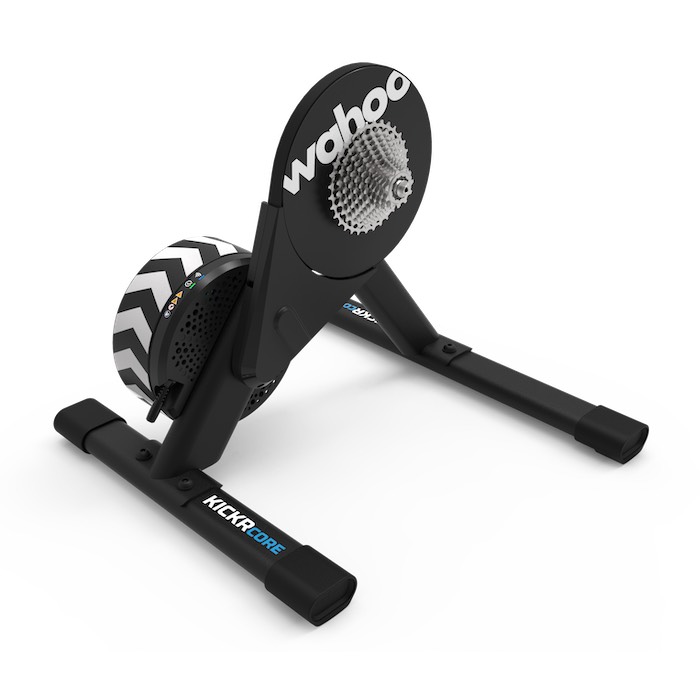
Explore this need in the finder →The KICKR CORE 2 is Wahoo's current mid-line direct-drive trainer in this review's US catalog snapshot. This page assesses the version sold with an 11-speed cassette already installed. Wahoo also lists a separate Zwift Cog and Click configuration; that package needs its own evaluation because virtual shifting equipment and the fitted rear interface are different. The recommendation here is conditional: the CORE 2 makes sense when a rider wants app-controlled resistance from a bike attached directly to the trainer, and the supplied cassette and axle arrangement fit that bicycle.
What the CORE 2 does well on paper
Its useful core is not a claim of dramatic realism but a clear operating arrangement. Remove the bike's rear wheel, seat its chain on the trainer cassette, secure its dropouts using the correct adapters, plug in the supplied AC power adapter, then connect a compatible training app or controller. Wahoo specifies electromagnetic resistance, trainer-reported power within ±2%, up to 1,800 watts and simulated gradients up to 16% uphill and 10% downhill. Those are maker specifications, not measurements taken for this assessment. They describe available headroom and data accuracy, not a guarantee of your own power-meter agreement, sprint performance or ride feel. For indoor sessions, the important functional distinction is automatic resistance control: Wahoo says connected software or a route can change the CORE 2's resistance. The unit reports power, speed, distance and cadence, with ANT+, ANT+ FE-C, Bluetooth and integrated Wi-Fi listed as connection routes. Wi-Fi adds automatic firmware updates and the KICKR Bridge sensor path; Bluetooth and ANT+ remain relevant for different app/device setups. Check the exact app's current device support and the devices' connection limits before assuming a particular phone, tablet, computer or bike computer can control every feature you want.The included cassette is convenient only if it matches
The reviewed package ships with a pre-installed 11-speed, 11-28-tooth cassette on a Shimano HG-standard freehub. That removes one installation step for a compatible drivetrain, but “cassette included” does not mean “every bike is ready.” Wahoo explicitly warns that the supplied cassette is not compatible with Shimano CUES/LinkGlide. A different cog count, freehub body, chain/derailleur system or preferred low gear can also call for another cassette or a separately available freehub. Its own compatibility notes warn that using a cassette that does not suit the bicycle can damage drivetrain parts. Before ordering, identify the rear drivetrain's exact cog count and brand/subtype, cassette tooth range, and rear axle standard; compare those facts with Wahoo's current drivetrain guidance. If the bike uses a different cassette, include the additional part and cassette-tool work in the plan rather than treating it as included. Wahoo lists adapters for 130/135 mm quick release and 12×142/148 mm thru-axles. That is a useful compatibility checklist, not proof of universal frame fit. Wahoo cautions that frame geometry and model-specific interfaces can still make a bicycle unsuitable even when its nominal hub standard matches. Consult both compatibility articles and get exact-model advice if the frame is unusual or valuable.Setup and room considerations
Direct drive means the rear wheel comes off; it is not a quick wheel-on clamp. You need enough clear floor area for the trainer and bicycle, a stable place for the front wheel, and access to a suitable AC outlet. Wahoo says the front-wheel block is sold separately. Repeated mounting also means thinking about where the removed wheel and bike can go between rides. The upside is that the rear tire is not being pressed against a resistance roller, but this assessment does not promise a particular room noise level: bicycle drivetrain condition, gearing, flooring, app connection and building acoustics still matter. The product page lists a maximum rider weight of 250 lb / 113 kg and claims up to 16% simulated uphill grade. Those limits should be checked against the actual rider and intended app mode. There is a specification discrepancy worth flagging: Wahoo's US product page reports a 30 lb product weight while its CORE 2 support FAQ lists a 43.5 lb unboxed weight. The source basis is not reconciled, so I do not quote a single carrying weight here. Buyers who need to move the trainer often should ask Wahoo to clarify the relevant net/package weight rather than plan around one figure.Who should compare another setup
Choose a wheel-on trainer if leaving the rear wheel fitted is a priority; check tire width, roller contact and tire wear for that design. Consider rollers if free bike movement and balance practice matter more than a fixed rear axle. A direct-drive CORE 2 is more appropriate when electronic resistance control and trainer-reported ride data are essential and the bike can be safely mounted with its rear wheel removed. If a simplified Zwift virtual-shifting package is the point, compare the separate Cog and Click SKU instead of assuming it is in this cassette box. This is a source-based assessment of Wahoo's specifications, setup and compatibility documents. I have not ridden, owned, assembled, measured, acoustically tested or laboratory-tested this trainer. The strongest practical recommendation is therefore to verify fit before comparing training features: exact cassette/drivetrain match, rear-hub standard, frame compatibility, power access and room should all be settled first.Key specifications
Key details at a glance
| Trainer setup | Direct-drive / rear wheel removed |
|---|---|
| App-controlled resistance | Yes |
| Manufacturer power accuracy | 2% |
| Manufacturer maximum resistance power | 1800 W |
| Maximum simulated uphill grade | 16% |
| Maximum simulated downhill grade | -10% |
| Cassette included in reviewed package | Yes |
| Included cassette speed count | 11 cogs |
| Included cassette tooth range | 11-28 |
| Included cassette/freehub standard | Shimano HG 11 |
| Zwift Cog and Click included in reviewed package | No |
| Listed connection protocols | ANT+ / ANT+ FE-C / Bluetooth / Wi-Fi |
| Listed ride metrics | power / speed / distance / cadence |
| Manufacturer maximum rider weight | 250 lb |
| Listed rear hub standards | 130 mm quick release / 135 mm quick release / 12 x 142 mm thru axle / 12 x 148 mm thru axle |
| AC power adapter included | Yes |
| Mains power required for powered resistance | Yes |
Use the exact model’s instructions for operating limits, supplied equipment and version differences.
Sources for this review
Sources for this assessment
See how this setup fits your own priorities.
The finder uses documented setup and feature differences. It is not a compatibility guarantee; verify your exact frame, drivetrain and supplied package.