
Your needs, this model
Does it fit your priorities?
Will this KICKR automatically change resistance during app-led sessions?
Wahoo says the KICKR automatically adjusts resistance based on connected software or a route when paired. The trainer uses its supplied AC adapter for controlled resistance, and the selected app and device still need to support the connection and workout mode. This is a documentation-based answer, not a ride test.
Explore this need in the finder →Does the reviewed package include a cassette?
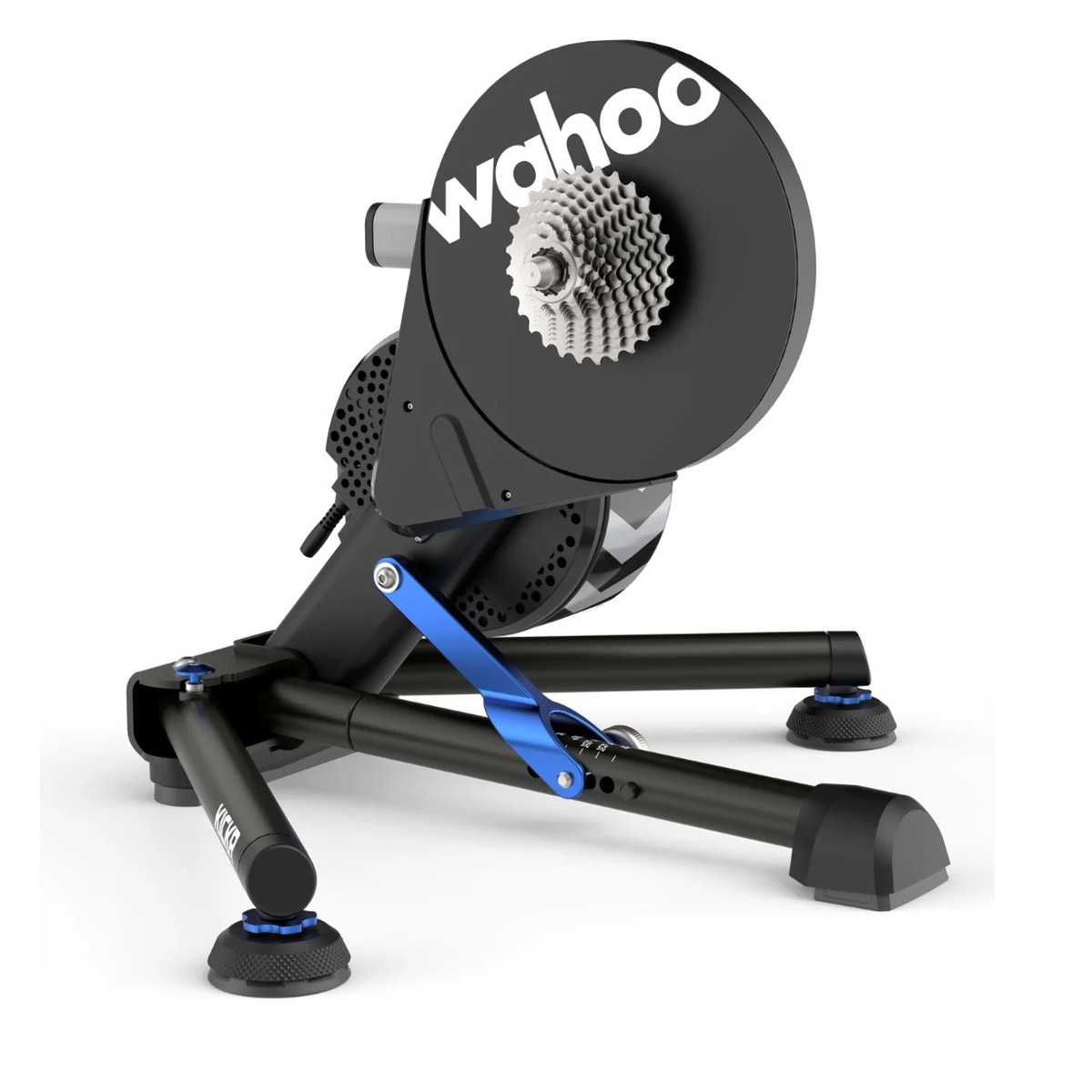
Yes. The current KICKR listing and v6 support documentation describe an 11-speed cassette as installed out of the box; Wahoo's product information specifies an 11-28 range. It is not automatically compatible with every chain, derailleur, cog count or preferred gear range, and Wahoo excludes CUES/LinkGlide from the supplied cassette setup.
Explore this need in the finder →Can I train with the bicycle's rear wheel still attached?
No. This is a direct-drive setup. Wahoo's KICKR instructions have the rider remove the rear wheel and mount the frame at the trainer axle. If retaining the wheel is essential, compare a wheel-on trainer instead.
Explore this need in the finder →This assessment covers Wahoo's current US KICKR listing with an 11-speed cassette, identified through Wahoo's support documentation as KICKR v6 (2022), part number WFBKTR122. Wahoo also sells this KICKR platform with Zwift Cog and Click instead; the two boxes are not interchangeable assumptions. This is a source-based review of the cassette configuration, not a hands-on test. Its strongest case is a rider who wants app-controlled direct drive and values the KICKR's higher published limits, but whose actual bicycle can use the fitted cassette and axle setup.
What separates this KICKR from the CORE 2
Wahoo specifies electromagnetic resistance, ±1% power accuracy, up to 2,200 watts and simulated grades of +20% uphill and −10% downhill for KICKR v6. Its separately reviewed CORE 2 has a lower published ceiling—±2%, 1,800 watts and +16%/−10%. Those numbers can help distinguish models when a rider has a particular requirement; they are not independent measurements and do not prove that a specific rider will reach a stated power or feel a grade difference. Most shoppers should settle bicycle fit, package and room setup before treating a higher maximum as a deciding factor.
The KICKR v6 also has Wi-Fi, Bluetooth, ANT+ and ANT+ FE-C, integrated cadence reporting and Wahoo's AXIS feet. The maker describes the trainer as automatically adjusting resistance from compatible software or a route. Wahoo's Race Mode support says v6 can increase broadcast frequency from its default 1 Hz to up to 10 Hz using Wi-Fi or a KICKR Direct Connect module; Bluetooth Race Mode is limited to Zwift. Direct Connect is a connection option, not an included feature I can verify in this cassette box. Race Mode is aimed at faster data updates, not a promise of faster fitness gains or race results.
The fitted cassette is convenient, not universal
The current KICKR product information describes an 11-speed, 11–28 cassette already installed. Wahoo's drivetrain guide explains that cog count, smallest and largest cog, chain/derailleur subtype and the trainer's freehub all matter. It specifically excludes Shimano CUES/LinkGlide from the stock cassette setup. Some riders may need a different cassette or freehub, and a different gear range may require an additional purchase and installation. Do not assume that “11-speed” alone proves compatibility: Wahoo notes that branded chains and derailleurs can have their own requirements, and a mismatched cassette can damage drivetrain parts.
Before ordering, write down your bike's cassette cog count, tooth range, drivetrain model and rear axle standard. Compare those details with Wahoo's current drivetrain compatibility guidance and the instructions from your bicycle's drivetrain maker. The installed cassette is helpful if it suits your chain and desired gearing; it is not a substitute for checking them. If you change the cassette, the review's “included” label no longer describes the setup you will ride.
Fit is a separate bicycle check
This is direct drive: remove the rear wheel, use the correct adapters, and seat the bike at the trainer axle. Wahoo lists adapters for 130 and 135 mm quick release and 12 × 142 and 12 × 148 mm thru-axle hubs. Its KICKR frame compatibility article also lists unsupported standards, known frame conflicts and conditional adapter cases. Wahoo cautions that matching a listed axle size does not guarantee that every frame fits. Check exact make, model, wheel size, dropout clearance and supplied adapters; do not force an uncertain or incompatible frame onto the trainer.
The package requires AC power for controlled resistance. Wahoo's setup guide recommends a stable, level surface and says to confirm the unit is secure before use. The v6 FAQ lists 47 lb as unboxed trainer weight, a practical consideration if you expect to carry it often or store it after every session. A floor mat, fan, front-wheel support for bikes that need leveling, or separate cassette could add space or cost, but none is represented here as included unless the exact listing says so.
Who should compare another configuration
Choose the Cog-and-Click KICKR package if virtual shifting and an installed single-speed Cog better fit your app use or household of bikes with differing cassette counts. It changes the drivetrain interface and control method; it does not change the base KICKR's stated resistance limits. Prefer the cassette box if you want conventional shifting with your bicycle's shifters and its cassette can be made compatible. Choose a wheel-on trainer if removing the rear wheel is a deal-breaker, and compare the CORE 2 if its documented power and grade limits already meet your needs and you want to evaluate a different cost tier.
Before making a decision, confirm the exact KICKR version, cassette or Cog package, axle adapters, frame compatibility, cassette needs, AC adapter and seller's box contents. Wahoo's product name on the US storefront is “KICKR Smart Trainer,” while its support material identifies the v6 hardware and part number; verify the matching details on any third-party listing. This assessment does not claim ownership, a ride, assembly, measured noise, laboratory testing or customer experience. It interprets manufacturer specifications and setup guidance; check Wahoo's current documents if firmware, compatibility or package contents change.
Key specifications
Key details at a glance
| Trainer setup | Direct-drive / rear wheel removed |
|---|---|
| App-controlled resistance | Yes |
| Manufacturer power accuracy | 1% |
| Manufacturer maximum resistance power | 2200 W |
| Maximum simulated uphill grade | 20% |
| Maximum simulated downhill grade | -10% |
| Cassette included in reviewed package | Yes |
| Included cassette speed count | 11 cogs |
| Included cassette tooth range | 11-28 |
| Included cassette/freehub standard | Shimano HG 11 |
| Zwift Cog and Click included in reviewed package | No |
| Listed connection protocols | ANT+ / ANT+ FE-C / Bluetooth / Wi-Fi |
| Listed ride metrics | power / speed / distance / cadence |
| Manufacturer maximum rider weight | 250 lb |
| Listed rear hub standards | 130 mm quick release / 135 mm quick release / 12 x 142 mm thru axle / 12 x 148 mm thru axle |
| AC power adapter included | Yes |
| Mains power required for powered resistance | Yes |
Use the exact model’s instructions for operating limits, supplied equipment and version differences.
Sources for this review
Sources for this assessment
See how this setup fits your own priorities.
The finder uses documented setup and feature differences. It is not a compatibility guarantee; verify your exact frame, drivetrain and supplied package.