
Your needs, this model
Does it fit your priorities?
Does Garmin FLUX 2 U.S. part T2980.60 include a cassette?
No. Garmin's U.S. buying guide and FLUX 2/S owner manual both say the cassette is not included, even though the trainer has a Shimano/SRAM cassette body. Select a cassette for your bike and verify the cassette family, freehub revision and spacers using the current Garmin guidance; Campagnolo, SRAM XD and XD-R are documented as requiring a different freehub body.
Explore this need in the finder →Will every FLUX 2 fit the same rear axle?
Do not assume that from the model name. Garmin says FLUX 2 units were made with Type 1 and Type 2 axle arrangements. Identify the unit's revision from its axle opening or installed cassette-body part number, then check the adapters supplied in that exact box against your bike's quick-release or thru-axle standard. If your frame needs a nonstandard adapter, confirm whether it is sold separately.
Explore this need in the finder →What grade does the FLUX 2 claim to simulate?
Garmin lists up to 16% simulated incline for FLUX 2. That is a maker-stated resistance limit; Garmin says its calculation assumes a 65 kg rider at 10 km/h and rider/bicycle mass can change the modeled maximum. It meets the finder’s 16% minimum, but not 17%, and is not an independent measurement or individualized hill guarantee.
Explore this need in the finder →This assessment concerns Garmin's U.S. FLUX 2 Smart Trainer listing, part T2980.60, rather than the related FLUX S or a retailer-created accessory bundle. Garmin's U.S. category and product sources identify the model, while a U.S. retailer listing supplies the T2980.60 identifier. This is a source-based review: I have not ridden the trainer, measured its noise or power, or verified fit on a bicycle.
A wheel-off smart trainer with a separate cassette decision
The FLUX 2 is direct drive. Remove the bicycle's rear wheel, then clamp the frame at the trainer's axle. It does not keep the tire against a resistance roller, and it is not a free-standing balance trainer. Garmin's U.S. buying guide describes app-controlled smart operation and names a cassette as not included. The trainer has a Shimano/SRAM-style cassette body, but that bare body is not a cassette and does not put the bicycle's drivetrain on the trainer by itself.
Before buying, identify the cassette family and speed arrangement your bike uses. Garmin's U.S. product comparison and the FLUX 2/S owner's manual do not state the same compatibility range: the comparison lists Shimano/SRAM 9–11 speed and Shimano 12-speed Hyperglide+, while the manual describes 8–10 speed cassettes with a spacer and 11–12 speed without one. The manual also says Campagnolo, SRAM XD and XD-R need a different cassette body. That wording difference is reason to check Garmin's current compatibility instructions against your exact cassette and trainer revision, not to assume every 12-speed system fits because the count appears on one list. The cassette itself, its spacer, and installation are additional setup decisions.
Check which FLUX 2 axle revision is in the box
“FLUX 2” does not identify just one axle arrangement. Garmin's support material says the trainer was manufactured in Type 1 and Type 2 forms. Type 1 has a smaller axle opening intended for a quick-release skewer; Garmin describes an adapter-kit route for compatible thru-axle bikes. Type 2 has a 12 mm axle opening and Garmin lists adapters for 142 × 12 mm and 148 × 12 mm as well as quick release. The manufacturer also provides a way to identify the trainer by its installed cassette-body part number or by measuring the axle opening. Check the unit and exact box contents before ordering rather than relying only on a broad “fits thru-axle” statement. If your bicycle uses an unusual length or standard, verify the separate adapter and whether it is supplied.
The shared U.S.-English manual lists a quick-release skewer, power cable, cassette spacer and several axle end caps, but Garmin's axle-in-box support page distinguishes contents for the Type 1 and Type 2 revisions. The exact seller package and production revision matter. Properly closing and securing the bicycle axle is a safety step, and Garmin directs the installer to check crank-arm clearance after mounting. Those instructions are not proof that every frame, dropout, brake or chain clears this trainer.
Smart control, power and calibration
Garmin lists Bluetooth and ANT+ connectivity and supports app-controlled resistance for the FLUX 2. The manufacturer describes compatible training apps and bike computers as control options, and its manual shows a powered, connected training mode. That should not be read as a promise that every app, computer, operating system or firmware version supports every workout function. Confirm the current software and connection method for the device you plan to use.
This model also has an important outlet requirement. Garmin says FLUX-series trainers need external power even in stand-alone mode; a disconnected but powered trainer simulates a flat road whose resistance rises as speed increases. That is a limited operating mode, not the equivalent of a fully app-controlled workout. Garmin lists spin-down calibration for FLUX 2, so it is not a zero-setup device after assembly. Plan for an outlet, the included country-specific power cable, and periodic setup in the supported app.
How to interpret the published numbers
Garmin publishes a 2,000 W maximum, a 16% simulated-incline limit, 41 Nm of torque, 120 N of brake force, and accuracy within/about 2.5%. The comparison also gives a 7.6 kg flywheel and 31.2 kg mass-inertia figure. These are manufacturer specifications, not measurements from this review. Garmin's support page says its 16% incline calculation assumes a 65 kg rider at 10 km/h, and that both rider and bicycle mass affect the modeled maximum. Treat 16% as a product-level simulation claim, not a personalized route or hill guarantee. In this review library, the FLUX 2 meets a 16% minimum and falls short of a 17% minimum.
The published dimensions are 670 × 642 mm at the base and 460 mm high; the listed trainer weight is 23.6 kg. Check the full operating footprint, not only the folded or stored position—Garmin lists this unit as a substantial direct-drive base, not a small roller set to lean casually in a closet. The heavy flywheel and accuracy statements describe intended performance, but neither can tell you how noisy it will sound through your particular floor or whether the ride sensation suits you.
What the image and package claims mean
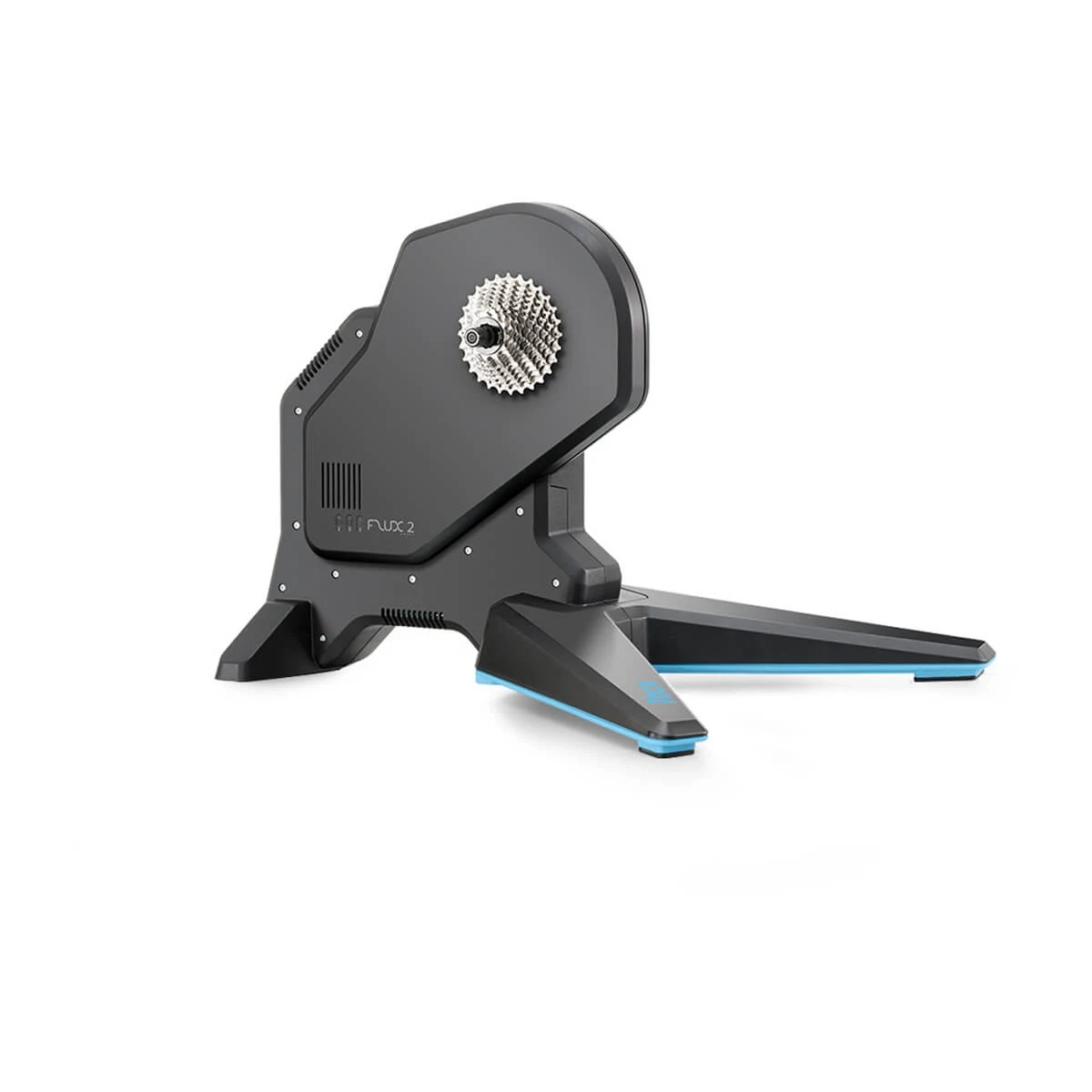
The official Garmin India model image used here shows a FLUX 2-branded trainer body with a cassette mounted on the freehub. It is a regional manufacturer image, not a photograph of the U.S. T2980.60 box; the cassette shown is not included according to Garmin's U.S. guide and manual. The picture establishes visual model identity but does not resolve the U.S. axle revision, all included adapters, or bicycle fit.
Who should compare this configuration
The FLUX 2 is a plausible candidate if you want a powered, app-controlled direct-drive trainer, can source and install a compatible cassette separately, and find the manufacturer's 16% grade and 2,000 W limits suitable for your use. Compare it with the FLUX S and higher-tier NEO models by their separately stated limits and features rather than assuming that the family name promises the same resistance range, accuracy or unpowered behavior. It is a poor assumption if you expect a cassette or Zwift Cog and Click in the box, need to ride without an outlet, require a particular cassette or nonstandard axle without checking the exact revision, or need a trainer that is light to move after each session. Confirm T2980.60, the Type 1/Type 2 axle configuration, cassette compatibility, included adapters, current app support and return terms in the exact offer. No price, future stock or independent test result is claimed here.
Key specifications
Key details at a glance
| Trainer setup | Direct-drive / rear wheel removed |
|---|---|
| App-controlled resistance | Yes |
| Manufacturer power accuracy | 2.5% |
| Manufacturer maximum resistance power | 2000 W |
| Maximum simulated uphill grade | 16% |
| Cassette included in reviewed package | No |
| Included cassette/freehub standard | Shimano/SRAM cassette body without cassette. Garmin's comparison and owner manual differ in listed Shimano/SRAM speed ranges and spacer wording; check the exact cassette, freehub and current manual rather than assuming a speed count guarantees compatibility. |
| Zwift Cog and Click included in reviewed package | No |
| Manufacturer-documented virtual-shifting apps | |
| Listed connection protocols | ANT+ / ANT+ FE-C / Bluetooth |
| Listed ride metrics | power / speed / cadence |
| Listed rear hub standards | 130 mm quick release / 135 mm quick release / 12 x 142 mm thru axle / 12 x 148 mm thru axle |
| AC power adapter included | Yes |
| Mains power required for powered resistance | Yes |
Use the exact model’s instructions for operating limits, supplied equipment and version differences.
Sources for this review
Sources for this assessment
- Garmin Tacx Indoor Bike Trainers — U.S. category
- Tacx FLUX 2 Smart Trainer — Garmin U.S. product page
- Tacx FLUX 2 product comparison — Garmin U.S.
- Tacx FLUX 2/S Owner's Manual — Garmin U.S. English PDF
- Tacx Smart Trainer Features — Garmin Support
- FLUX Smart and NEO Smart Series Axles in the Box — Garmin U.S. Support
- Which Type of Axle Do I Have on My Tacx Trainer? — Garmin Support
- How to choose the best indoor bike trainer for you — Garmin U.S.
- Tacx FLUX 2 Smart Trainer — Pro Bike Supply U.S. listing
- Tacx FLUX 2 Smart Trainer — Garmin India product image

See how this setup fits your own priorities.
The finder uses documented setup and feature differences. It is not a compatibility guarantee; verify your exact frame, drivetrain and supplied package.