
Your needs, this model
Does it fit your priorities?
Does the Saris M2 remove the bike's rear wheel?
No. SKU 9930T is wheel-on: Saris says the rear wheel remains installed and its tire contacts the trainer's resistance roller. Check the exact tire diameter, width and tread, rear spacing and axle hardware; a wheel-on label alone does not prove your bicycle fits.
Explore this need in the finder →Can supported software control M2 resistance automatically?
Saris documents fast-response electromagnetic resistance, dual ANT+ FE-C and Bluetooth, and compatibility with indoor apps. Its product page also describes a powered headless mode with a progressive curve. Confirm the app, device and firmware features you intend to use; the protocol list is not a promise that every application exposes every workout mode.
Explore this need in the finder →Does the M2 package include a cassette, speed sensor or Cog?
The 9930T box list includes the trainer, power supply, frame, spring-loaded hardware, clutch knob and steel quick-release skewer. Saris lists integrated speed, cadence and power sensing, but no trainer cassette or Zwift Cog and Click. The bicycle keeps its own rear wheel and drivetrain.
Explore this need in the finder →What should I check for M2 tire and axle fit?
Saris lists 650b and 700c wheels, 27.5-inch tires up to 2 inches, and 29-inch tires up to 1.5 inches only without tread; it excludes 650c, 20-inch and 26-inch wheels and treaded or wider-than-1.5-inch 29-inch tires. The trainer includes a steel quick-release skewer, while Saris says 142 x 12 mm and 148 x 12 mm adapters are sold separately. Confirm your exact wheel, axle and frame before ordering.
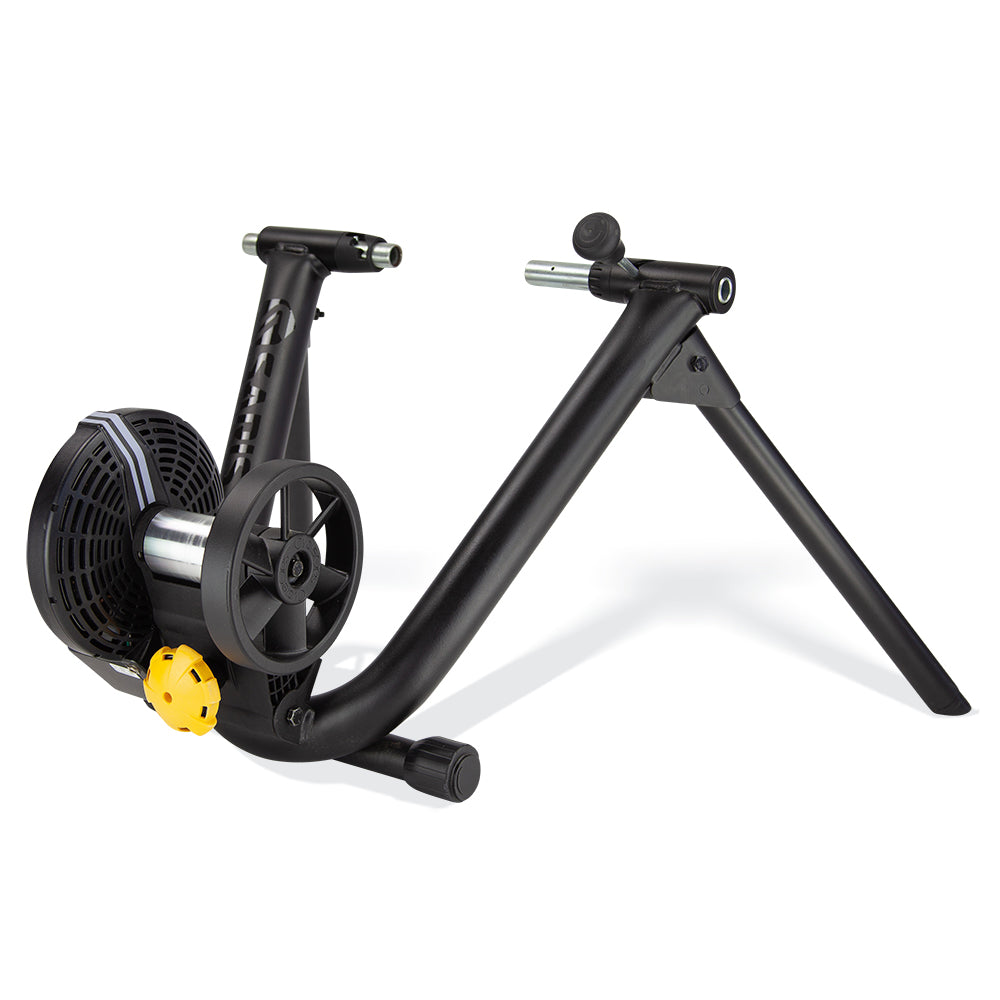
Explore this need in the finder →The Saris M2 Smart Indoor Bike Trainer is a wheel-on electromagnetic model identified as U.S. SKU 9930T. Saris describes automatic resistance control through compatible training software, plus integrated speed, cadence and power reporting. This is a source-based assessment of the listed configuration, not a ride test; it cannot tell whether a particular bicycle, app, room or rider will suit the trainer.
App control is the meaningful distinction
The M2 is not simply a resistance unit with a sensor attached. Saris identifies its resistance as fast-response electromagnetic and describes supported software communication over ANT+ FE-C and Bluetooth. That places it in a different use category from a conventional fluid trainer whose brake reacts to wheel speed. The trainer also has a powered headless mode: Saris says that without a paired app it follows a progressive resistance curve similar to its Fluid². This is a useful nuance for riders who may sometimes want a plain ride, but it does not establish which app modes work on every phone, computer or firmware version.
Manufacturer literature lists 15% simulated grade, a 1,500-watt maximum and ±5% power accuracy. Those are Saris specifications, not measurements made for this review. A published incline figure is not a promise that every virtual route or rider will feel the same, and the accuracy claim should not be confused with an independent comparison against a separate power meter. The product page also lists integrated speed, cadence and power sensors, so the 9930T does not need an external sensor for those named metrics.
Wheel-on changes the installation tradeoff
The rear wheel remains on the bike and its tire contacts a roller. That can make the drivetrain side of setup simpler than a direct-drive trainer: there is no trainer cassette to choose for this package, and the bicycle retains its own cassette and rear wheel. But wheel-on fit is not automatically easy. Saris gives a list of wheel and tire combinations and excludes some sizes, including 650c, 20-inch and 26-inch wheels and 29-inch tires that are treaded or wider than 1.5 inches. It recommends a trainer tire, which is not listed in the 9930T box.
Saris lists rear spacing positions of 120, 130 and 135 mm, includes a steel quick-release trainer skewer and says adapters for 142 x 12 mm and 148 x 12 mm thru-axles are sold separately. Its manual emphasizes using the supplied skewer for quick-release bikes and the correct Saris accessory for thru-axle setups. Check the bicycle's exact axle standard, dropout spacing, wheel diameter, tire width and tread before assuming the trainer will work. The manufacturer also sets a combined rider-and-bike limit of 300 pounds; that is not a rider-only allowance.
What comes with the 9930T
The Saris page lists the trainer resistance unit, power supply, frame, spring-loaded tube and lollipop lever, clutch knob and steel quick-release skewer. Its documented package does not include a trainer cassette or Zwift Cog and Click. Because the bike stays wheel-on, this is not a missing cassette problem in the same sense as a bare direct-drive unit; it is the normal rear-wheel setup. Still, confirm the seller's exact part number and shipment contents, especially for used or open-box offers.
The M2 needs power for its electronic features. That adds a household outlet and cord-routing question that a passive magnetic or fluid trainer does not have. Saris lists 69 dB at 20 mph, but this manufacturer figure cannot predict noise in a particular room. Tire construction, pressure, roller contact, floor and surrounding surfaces all matter; the number is a condition-specific reference rather than an independent sound test.
Where it fits—and where it may not
The M2 is worth considering when the desired routine includes app-directed resistance and the bicycle falls within the published wheel-on limits. It is less suited to someone who wants a completely unpowered setup, a direct-drive interface or a trainer known to fit without checking tire and axle details. Riders who mainly want speed data rather than automatic resistance may find that a basic trainer paired with a separate sensor addresses a different task, often with fewer electronic features to configure.
Before buying, verify SKU 9930T, the exact bike's fit, the included power supply and skewer, and whether the chosen app/device supports the workouts you intend to use. Treat the 15% grade, 1,500 watts, ±5% accuracy and 69 dB figures as maker-published specifications. The M2's key strength is a documented smart brake in a wheel-on form; its key caution is that neither the product label nor the trainer's general compatibility list proves a particular home setup.
Key specifications
Key details at a glance
| Trainer setup | Wheel-on / rear tire on |
|---|---|
| App-controlled resistance | Yes |
| Manufacturer power accuracy | 5% |
| Manufacturer maximum resistance power | 1500 W |
| Maximum simulated uphill grade | 15% |
| Cassette included in reviewed package | No |
| Zwift Cog and Click included in reviewed package | No |
| Listed connection protocols | ANT+ FE-C / Bluetooth |
| AC power adapter included | Yes |
| Mains power required for powered resistance | Yes |
Use the exact model’s instructions for operating limits, supplied equipment and version differences.
Sources for this review
Sources for this assessment

See how this setup fits your own priorities.
The finder uses documented setup and feature differences. It is not a compatibility guarantee; verify your exact frame, drivetrain and supplied package.