
Your needs, this model
Does it fit your priorities?
Does Fluid² Smart Equipped change resistance automatically in Zwift?
No app-controlled resistance is documented for 9907T. Saris describes a progressive fluid resistance unit that responds to wheel speed. Its included sensor sends speed or cadence data to software; that telemetry does not command the fluid brake.
Explore this need in the finder →What does the 'Smart Equipped' 9907T package add?
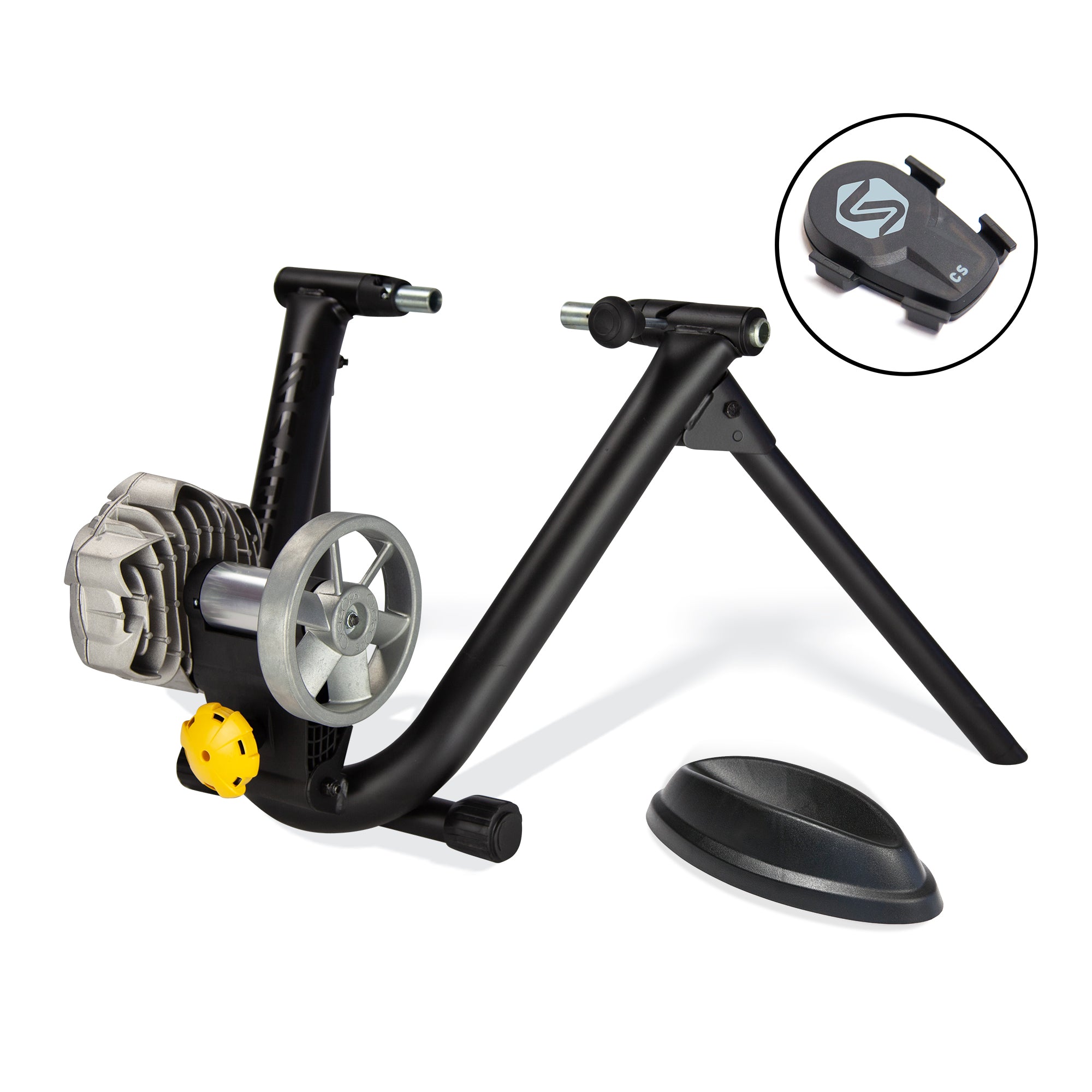
Saris lists the trainer plus a dual-band magnetless speed-or-cadence sensor and leveling block. Those are meaningful package differences from basic Fluid² 9904T, which lists no sensor in its box. The 9907T remains a fluid trainer rather than a smart resistance-control trainer.
Explore this need in the finder →Does the 9907T sensor measure power?
The Saris product page identifies the included item as an external speed or cadence sensor and lists ANT+ and Bluetooth. It does not publish a trainer power-meter accuracy for this package; do not treat estimated app output or cadence/speed telemetry as measured power.
Explore this need in the finder →How does the 9907T compare with basic Fluid² for bicycle fit?
Both listings describe a wheel-on Fluid² arrangement with the same listed 120, 130 and 135 mm rear-spacing settings, included steel quick-release skewer, and separately sold 142 x 12 mm and 148 x 12 mm adapters. Saris's tire list includes 650b/700c, 27.5-inch tires up to 2 inches, and smooth 29-inch tires up to 1.5 inches; the 9907T page excludes 650c, 26-inch and treaded or wider 29-inch setups. Verify your exact wheel, axle and frame.
Explore this need in the finder →The Fluid² Smart Equipped trainer, Saris SKU 9907T, sits between a basic wheel-on fluid trainer and a genuinely interactive smart trainer. The exact package adds an external magnetless sensor and leveling block to the Fluid² platform, so ride data can reach compatible apps without separately sourcing that sensor. But its fluid brake still follows wheel speed; the app does not set resistance. The word “Smart” in the package name should not obscure that functional distinction.
Data-equipped is not resistance-controlled
Saris describes the included sensor as a dual-band magnetless speed or cadence sensor and lists ANT+ and Bluetooth. It can send the selected ride metric to supported software. The product page describes the resistance itself as a fluid unit with a progressive curve, not the M2's controlled electromagnetic brake. That means a route or workout in an app should not be assumed to change 9907T resistance automatically. Software may use the data for a virtual ride or training display, but that is not the same capability as an app-commanded trainer.
The sensor is also not documented as a trainer power meter. Saris's 9907T page does not publish a power-accuracy percentage or a maximum-watt capability for this configuration. Avoid treating estimated app output as if the trainer measured power. If precise power or automatic resistance is central to the decision, look for a product whose exact model page documents those functions rather than relying on the “Smart Equipped” name.
The 9907T package differs from two close relatives
Compared with basic Fluid² 9904T, the 9907T page lists an included dual-band sensor and leveling block. That is a real package distinction: the basic model page says a speed sensor is needed for app connection and does not list one in the base box. Compared with Saris's separate AMZSAR9907TKIT1 bundle, 9907T has its own SKU and contents list. The bundle is presented with a wheel riser, training mat and towel; those items should not be transferred to the 9907T box by assumption. Conversely, the bundle is not just the 9907T page with a different name.
Saris lists the 9907T package with the trainer, sensor and leveling block, as well as the classic frame, quick-release skewer and assembly pieces. It does not list a trainer cassette or Zwift Cog and Click. As a wheel-on model, it keeps the bicycle's regular rear wheel and drivetrain installed. Confirm the seller's exact SKU and whether the box is complete, especially if buying used or open-box.
Wheel and axle checks still matter
The 9907T is not a direct-drive system: the rear tire rests against the resistance roller, and tire fit affects the setup. Saris lists 650b and 700c wheels, 27.5-inch tires up to 2 inches wide, and 29-inch tires up to 1.5 inches without tread. It excludes 650c, 26-inch and treaded or wider 29-inch tires. A trainer tire is recommended but not listed as included.
Saris's supported spacing positions are 120, 130 and 135 mm, with a steel quick-release skewer included. The product page says 142 x 12 and 148 x 12 mm thru-axle adapters are sold separately. The manual explains the quick-release setup and correct roller-to-tire contact. Check the exact bike's axle type, dropout spacing, tire, brake clearance and frame before ordering. Saris publishes a 300-pound combined rider-and-bike limit, which is not a rider-only maximum.
What its published figures do—and do not—say
Saris lists 69 dB at 20 mph for the Fluid². This is a manufacturer figure under a stated speed condition rather than a room-specific prediction. Tire pressure and compound, floor construction, cadence and nearby walls can affect the actual sound. The page does not state a maximum simulated grade or trainer power-accuracy value for 9907T; a missing number should stay unknown, not be copied from M2 or H3 Plus.
The 9907T may make sense for a rider who wants a passive, mechanical trainer and likes having a sensor ready for app data. It may not suit someone who expects the app to raise or lower resistance, needs a documented climbing grade, or wants an included cassette. Check the sensor type, pairing route, exact package, tire and adapter requirements before purchase. The package adds convenience for data collection, not a different brake behavior.
Key specifications
Key details at a glance
| Trainer setup | Wheel-on / rear tire on |
|---|---|
| App-controlled resistance | No |
| Cassette included in reviewed package | No |
| Zwift Cog and Click included in reviewed package | No |
| Listed connection protocols | ANT+ / Bluetooth |
| AC power adapter included | No |
| Mains power required for powered resistance | No |
Use the exact model’s instructions for operating limits, supplied equipment and version differences.
Sources for this review
Sources for this assessment

See how this setup fits your own priorities.
The finder uses documented setup and feature differences. It is not a compatibility guarantee; verify your exact frame, drivetrain and supplied package.