
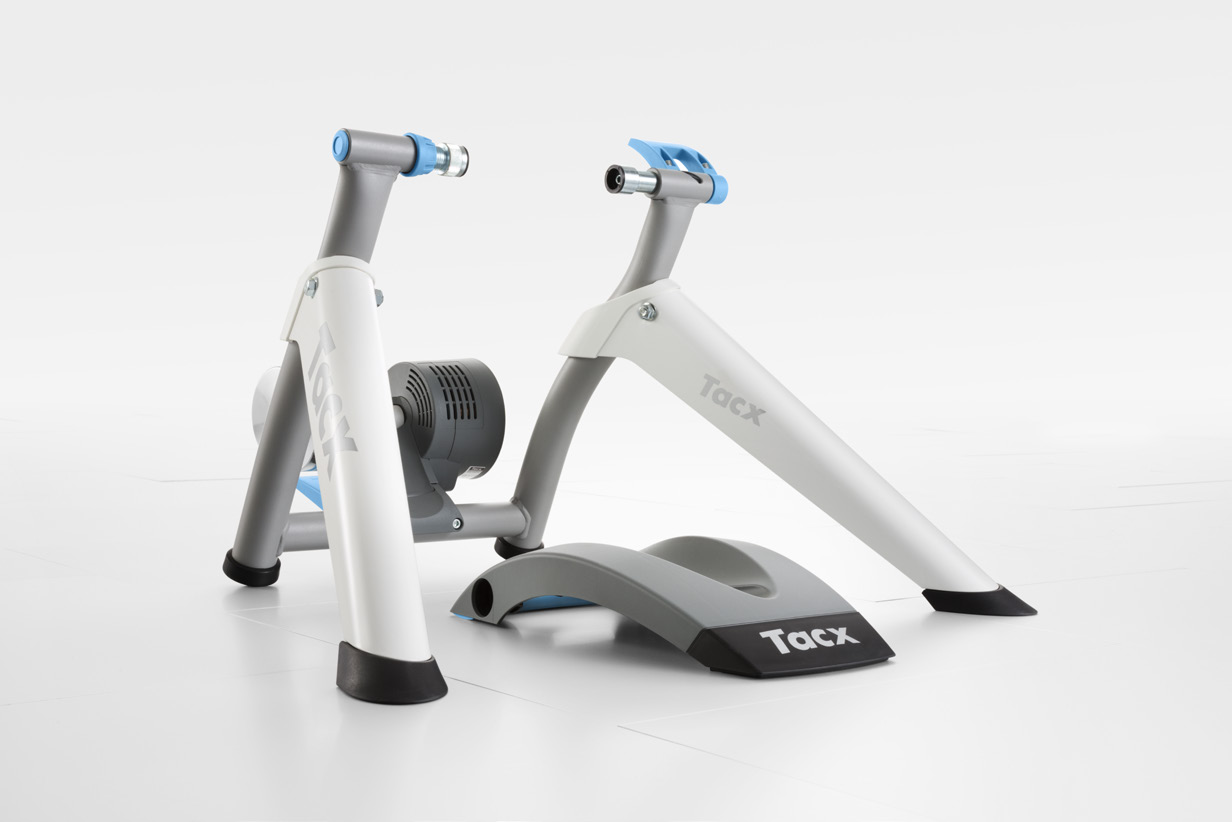
Your needs, this model
Does it fit your priorities?
Can the Flow Smart T2240 change resistance from a compatible app?
Yes. Tacx classifies T2240 as an interactive smart trainer, and Garmin lists Flow among legacy Tacx Training-compatible models. Confirm support for the exact app, device, firmware and workout mode rather than assuming every software feature remains available.
Explore this need in the finder →Does the Flow T2240.60 keep my bicycle's rear wheel installed?
Yes. It is a wheel-on trainer: the rear tire remains installed and contacts the resistance roller. Check the bicycle's axle, tire, wheel size and clearance; the training base has no trainer cassette or Zwift Cog/Click package.
Explore this need in the finder →Does T2240 meet a 6% grade floor or sustain hard ERG indefinitely?
Tacx's table lists a 6% maximum, so it meets 6% but not 7%. Garmin warns that prolonged ERG above 250 W or sustained steep climbing can trigger overheating protection and temporarily stop resistance; it suggests more flywheel speed or a lower app slope. Neither statement predicts a specific rider's route feel.
Explore this need in the finder →This is a source-based assessment of the earlier Tacx Flow Smart Trainer, U.S. model T2240.60, not a hands-on test. Best Buy's U.S. listing identifies T2240.60 and SKU 6375942, and states that new-condition sales are no longer available. That is a dated listing state only: it says nothing about future inventory, used offers or a box supplied by another seller. Garmin's T2240 instructions, the Flow parts sheet and Tacx's 2019–2020 trainer overview describe the model more usefully than a generic retailer snippet.
Wheel-on convenience leaves the tire on the bicycle
Flow holds the rear axle in its frame and presses the installed rear tire against a resistance roller. The bicycle keeps its own rear wheel and cassette. That makes it a wheel-on trainer, not a direct-drive trainer whose cassette body takes the place of the rear wheel and not a free-standing roller set on which the rider balances. You do not buy a trainer cassette or Zwift Cog/Click for this base configuration, but the actual seller may offer extra accessories, so check the precise box.
Wheel-on setup depends on the actual tire, wheel, axle interface and frame clearance. The T2240 manual illustrates the resistance cylinder and fitting procedure; it does not prove that a particular vintage or used unit includes every axle part. Check the seller's exact fittings and read the tire/rim maker's pressure limits. The generic pressure drawing in the instructions is not a replacement for the limits on your own tire and wheel.
Flow changes resistance from supported software
Tacx calls Flow an interactive smart trainer. The manufacturer table identifies an electric brake, Bluetooth and ANT+ FE-C, and Garmin lists T2240 in its legacy Tacx Training-compatible trainer group. Compatible software can change resistance for supported workouts. That capability is different from merely transmitting speed, cadence or power data, but it does not mean every app, phone, computer or workout remains compatible with this older trainer.
Unlike the self-powered Bushido T2780, Flow requires mains power; Tacx's overview lists 110–240 V. The U.S. product listing and manual do not establish what a particular old-stock or used seller will ship. Confirm the correct supply and plug for the specific unit before ordering, rather than assuming a photographed cable is included.
The 800 W and 6% numbers have boundaries
Tacx's 2019–2020 overview lists a maximum resistance of 800 W, power accuracy below 5%, and a 6% simulated-grade ceiling with a 75 kg total-weight footnote. Garmin's support comparison likewise says the grade maximum varies with rider mass and cycling speed; it notes that bike mass also affects the simulation. These are maker specifications, not test results or a personalized estimate of the hill a rider can reproduce. In a numeric finder, the documented 6% ceiling meets a 6% minimum but does not meet 7%. The strict accuracy statement does not mean exactly 5%.
Heat management is a real limitation to weigh
Garmin's Flow-specific support warns that prolonged ERG training above 250 W can trigger overheating protection, and that a sustained steep climb can also cause the resistance to stop temporarily while the trainer cools. Garmin recommends increasing flywheel speed by using a harder gear, or lowering the app's slope. That is a manufacturer operating warning, not an independent failure-rate claim. It gives a buyer a practical question: will this trainer's published 800 W peak matter less than how it behaves during a long high-load interval?
Garmin's comparison lists spin-down calibration for Flow. Calibration, tire pressure, roller contact and room temperature are separate from the grade number; follow the exact manual and app procedure for the particular unit. Do not infer condition or calibration state from a retailer photograph.
Who should keep Flow on a shortlist?
Flow is a reasonable source-based candidate for someone who specifically wants app-controlled wheel-on resistance, accepts AC power and does not need a documented grade limit above 6%. It is less attractive if sustained hard ERG work is central, if tire contact is undesirable, or if the seller cannot show the right fittings and power supply. Compare it with the Vortex T2180, whose 7% table limit is higher but whose own support documents protection during extended full-power use; don't transfer one model's limit or condition to the other. No use, noise measurement, test ride or ownership is claimed.
Key specifications
Key details at a glance
| Trainer setup | Wheel-on / rear tire on |
|---|---|
| App-controlled resistance | Yes |
| Manufacturer maximum resistance power | 800 W |
| Maximum simulated uphill grade | 6% |
| Cassette included in reviewed package | No |
| Zwift Cog and Click included in reviewed package | No |
| Listed connection protocols | Bluetooth / ANT+ FE-C |
| Listed ride metrics | speed / cadence / power |
| Mains power required for powered resistance | Yes |
Use the exact model’s instructions for operating limits, supplied equipment and version differences.
Sources for this review
Sources for this assessment
- Tacx Training App Compatibility and Requirements — Garmin Support reader
- Tacx Trainer Overview 2019–2020 (English manufacturer brochure)
- Flow Smart T2240 assembly and owner instructions — Garmin/Tacx
- Flow Smart T2240 spare-parts sheet — Garmin/Tacx
- Tacx Smart Trainer Features — Garmin Customer Support reader
- Tacx Flow Smart Trainer: Light Flashing Red After Intense Workout — Garmin U.S. Support
- Tacx Flow Smart Trainer System T2240.60, SKU 6375942 — Best Buy U.S.
See how this setup fits your own priorities.
The finder uses documented setup and feature differences. It is not a compatibility guarantee; verify your exact frame, drivetrain and supplied package.